Anyone hoping to expand their online business must understand how buyer behavior is changing. This change is happening faster than many online stores can keep up with. The new DHL 2026 E-Commerce Trends Report focuses precisely on this gap between consumer expectations and current offerings.
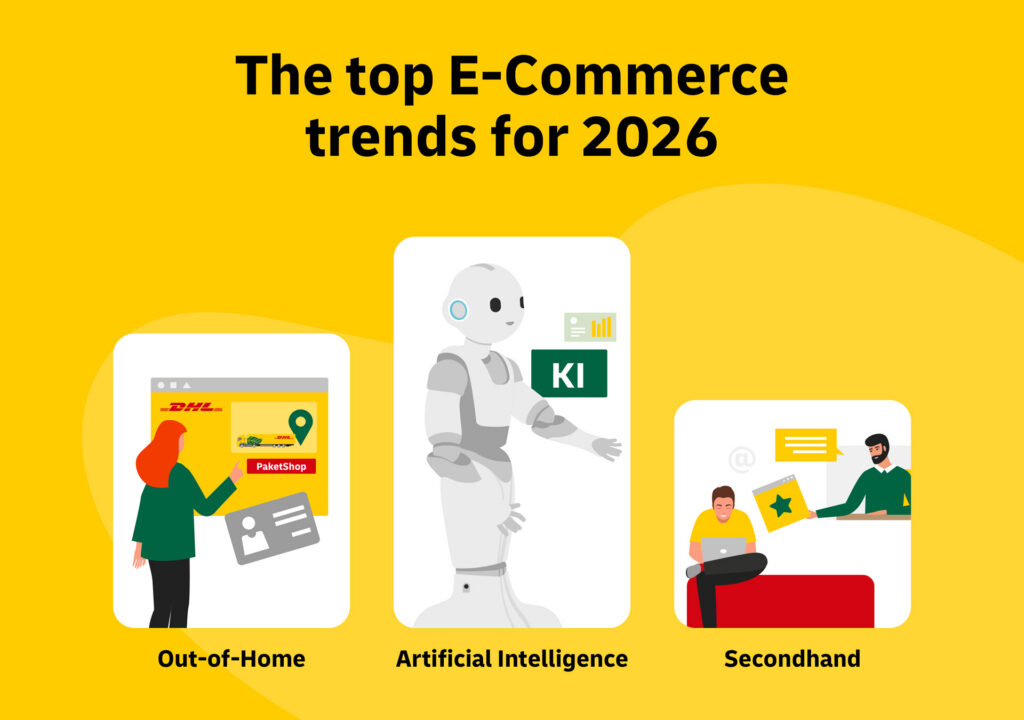
Three trends, in particular, are shaping the report: First, artificial intelligence is evolving from a support tool to a decision-maker. Second, out-of-home delivery is becoming the norm. Third, more and more consumers are becoming sellers themselves. We summarize the key insights and explain their implications for retailers and their logistics.
What Is the Data Behind the DHL 2026 E-Commerce Trends Report?
For this year’s report, DHL eCommerce surveyed 29,000 online shoppers and 5,800 e-commerce companies in 29 countries across Europe, North America, the Asia-Pacific region, Latin America, the Middle East, and sub-Saharan Africa. For the first time, the report incorporates insights from applied futurist Tom Cheesewright, who translates the findings into long-term forecasts.
The report’s unique value lies in its dual perspective. It presents the views of buyers and companies side by side. This reveals where the two groups’ perspectives are diverging.
For many retailers, this discrepancy has become a barrier to growth. Quickly completing an order is no longer enough. Retailers need to establish trust in the checkout process, offer flexible payment options, and provide convenient, locally tailored delivery solutions.
Trend 1: Will Shopping Soon Be Taken Over by AI?
Perhaps the most significant finding concerns the role of AI in the purchase process. AI is evolving from a supportive tool into an entity that actively makes decisions.
Nearly a Third Would Leave It Up to AI to Decide
- Readiness grows: 29% of customers are open to letting AI take control of their purchases within the next five years. This percentage is higher among younger generations: 33% among Generation Z and 36% among Millennials.
- Companies anticipate change: 59% of respondents expect that, in the future, customers will use virtual assistants to search for and purchase products. 73% plan to make greater use of generative AI over the next five years.
- Trust is still the main challenge: 48% of shoppers express concerns – especially regarding data protection and trust.
Which AI Features Are Already Part of Everyday Life?
Examining specific features illustrates just how deeply AI is already embedded in e-commerce. From a buyer’s perspective, the most frequently used applications are product reviews and images, chatbots for customer service, and price comparison.
Companies primarily focus on personalization, chatbots, and AI-powered product presentation. Voice-activated search, automatic reordering, and virtual try-ons are less common, so there is still potential here.
From Online Store to “Bot Front”
Tom Cheesewright takes it a step further. He predicts that companies will use “bot fronts” instead of traditional websites or apps in the future.
These AI-powered systems will interact directly with consumers’ personal AI assistants to negotiate personalized offers and terms. In that case, the next customer to “knock” on a store’s door might not be human.
Trend 2: Will Out-of-Home Become the New Standard for Delivery?
Despite all the technology, the decision to make a purchase is often still based on tangible factors such as delivery, returns, and payment methods. Convenience and flexibility are key.
Convenience Is the Deciding Factor in Purchasing Decisions
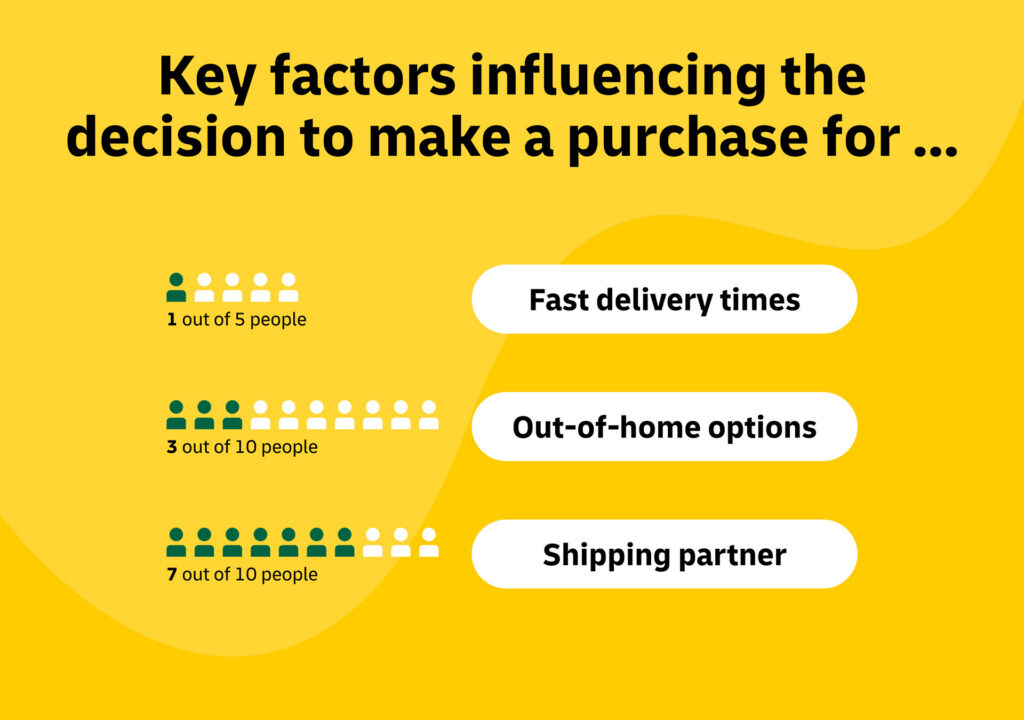
- 20% of respondents indicate that faster delivery times would prompt them to make a purchase more often.
- Three in ten now use out-of-home options, such as parcel shops and lockers, to better organize their daily lives.
- Seven out of ten shoppers cite trust and shipping partner choice as key criteria when selecting a brand.
Demand for flexible delivery options will continue to grow, driving the expansion of out-of-home delivery and returns.
Tom Cheesewright
Applied Futurist
Where Expectations and Supply Diverge
The expectation gap is particularly evident when it comes to payment methods. 62% of shoppers will abandon a purchase immediately if their preferred payment method is unavailable, yet only 45% of companies view this as a major reason for abandoned carts.
Free shipping and returns remain strong incentives to buy. However, they present ongoing challenges for retailers in terms of cost and profit margin.
Trend 3: From Shopping to Selling: Is Secondhand Becoming Mainstream?
The distinction between buyers and sellers is becoming blurred. Consumer-to-consumer (C2C) commerce via online marketplaces has evolved from a niche phenomenon into an integral part of everyday life.
One in Two People Has Sales Experience
- 52% of consumers have sold something through an online marketplace. The figures are 62% among millennials, 58% among Generation Z, and 35% among baby boomers.
- In a global comparison, Europeans are the most active sellers. 57% of them do so regularly.
- 45% of respondents buy secondhand or refurbished products for environmental reasons, and 15% are considering doing so.
What the Comparison of Countries Reveals
A country-by-country comparison reveals just how widespread reselling is in the most active markets. Between 57% and 67% of respondents in the top ten markets say they have sold something via an online marketplace at least once. Germany and the Netherlands lead the way with 67% each.
The preferred shipping method is striking: In most countries, out-of-home options, such as parcel drop-off points and parcel lockers, dominate. Thus, the C2C trend and the desire for flexible delivery reinforce each other.
Sustainability Is Becoming the Norm
This creates a new competitive landscape for companies. Consumers are both the target group and the competition.
Within the next decade, three-quarters of adults will be recycling their furniture, fashion, and tech through marketplaces.
Tom Cheesewright
Applied Futurist
At the same time, things that customers take for granted are changing. For a long time, having a reduced carbon footprint in logistics has been a way for companies to stand out. However, 42% of respondents now simply expect businesses to be sustainable within the next five years.
The ability to understand and respond to customer needs has always defined success – but our new eCommerce trend report shows that AI is now redefining that advantage at hyperspeed. Consumers can identify the best offer in milliseconds, and retailers can gain insights that allow them to instantly capitalize on changing demand. For those of us powering the delivery infrastructure behind e-commerce, AI enables new levels of speed, flexibility, and precision. In this new era, the winners will be those who move fastest – and translate that speed into superior customer experiences.
Pablo Ciano
CEO DHL eCommerce
What Do These Trends Mean for DHL and the Logistics Industry?
DHL not only documents evolutions in e-commerce but is already putting them into practice.
Out-of-Home in Practice: The Case of Sweden
Sweden is a good example. Here, DHL Freight not only handles traditional road freight, but also e-commerce operations and nationwide B2B and B2C parcel services.
A dense network is crucial for the out-of-home trend. In Sweden, the network includes approximately 2,000 parcel stores and over 1,000 parcel lockers, with an additional 5,000 expected to be added within the next two years. This offering is complemented by pilot projects, such as the Smarcel mobile parcel locker in Stockholm. These projects directly address the flexibility and convenience expectations described in the report.
Reducing Emissions – Concrete Measures Instead of Blanket Approaches
DHL is also addressing the growing demand for lower-emission logistics. Through its GoGreen Plus product, shippers can reduce the emissions associated with their shipments through measures such as using alternative fuels.
DHL Group’s goal is to achieve net-zero emissions in logistics by 2050, which will meet long-term customer expectations highlighted in the report.
E-Commerce in Transition: Those Who Adapt Will Succeed
With AI involved in decision-making, out-of-home as the new normal, and consumers becoming retailers themselves, the DHL 2026 E-Commerce Trends Report paints a picture of a rapidly transforming market. A common theme running through all three trends is the disparity between what shoppers expect and what many stores currently offer.
Closing this gap gives companies a competitive edge. The key is a logistics system that combines speed, reliability, and flexibility at every step, from checkout to returns.
This is precisely where we see our role as a partner: supporting retailers with insights, experience, and tailored solutions.
The full report is available for free download. You can find a recap of last year's edition in the article on the 2025 E-Commerce Trends Report.
FAQs on 2026 E-Commerce Trends
What is the DHL 2026 E-Commerce Trends Report?
The DHL 2026 E-Commerce Trends Report is a global study by DHL eCommerce examining the habits of 29,000 online shoppers and 5,800 businesses across 29 countries. The report highlights significant changes in online retail, from AI to delivery to second-hand goods, and provides retailers with practical guidance for the coming years.
Will AI soon be making purchasing decisions in online retail?
According to the report, 29% of consumers would entrust an AI with control over their purchases within the next five years. Among Generation Z, this figure rises to 33%. Meanwhile, 59% of companies expect customers to use virtual assistants to search for and purchase products in the future.
Why is out-of-home delivery becoming more important for online retailers?
Out-of-home delivery to parcel shops and lockers is becoming more important because shoppers want convenience and flexibility. In fact, three in ten shoppers already actively use these options. Since seven in ten also cite trust and choice of shipping partner as key criteria, it is becoming clear that a reliable, flexible delivery network is a real competitive advantage.
What does the C2C trend mean for e-commerce companies?
The growth of peer-to-peer commerce is changing the competitive landscape: 52% of consumers have already sold items through online marketplaces, and in Europe, that figure rises to 57%. As a result, customers are also becoming competitors. For businesses, this means they need to differentiate themselves more strongly through service, trust, and seamless logistics.
What role does low-emission logistics play in the 2026 Report?
The role is growing. Over the next five years, 42% of respondents expect reduced-carbon-footprint logistics to become standard rather than a bonus. Furthermore, 45% of respondents purchase secondhand or refurbished products for environmental reasons. Thus, lower-emission shipping options are evolving from a competitive advantage to the norm.