Transport and logistics are vital, but they also contribute significantly to global greenhouse gas emissions. Reducing this ecological footprint is both a challenge and an opportunity. After all, sustainability ensures the future viability of logistics market participants. What strategies can be employed to reduce emissions in the transportation and logistics industries?
What Is the Carbon Footprint of the Transportation and Logistics Industry?
Logistics and transportation are the backbone of the modern global economy. In 2020, the total volume of goods transported by sea, land, or air exceeded 100 trillion tons. The importance of global logistics continues to grow as demand for logistics services steadily rises with the growth of economies in Africa, Asia, and Latin America.
The private sector is growing at equal speed. Approximately 161 billion parcels were shipped worldwide in 2022.
The Economic Importance of Logistics Is Reflected by Its Environmental Impact
Global logistics moves massive amounts of goods, providing people with necessities and conveniences while keeping the economy running. However, this comes at an environmental cost. As the economic importance of logistics increases, so does its contribution to global pollution. The exact environmental impact and carbon footprint of logistics can only be estimated.
Why Are There Different Figures for the Carbon Footprint of Logistics?
Because the ecological footprint of logistics is multifactorial, some sources show higher values than others. Logistics permeates all links in the value and supply chains. For example, when considering emissions data, the values for passenger transport must be deducted, or the emissions from warehouse logistics must be derived from statistics on building emissions. In short, it is complex.
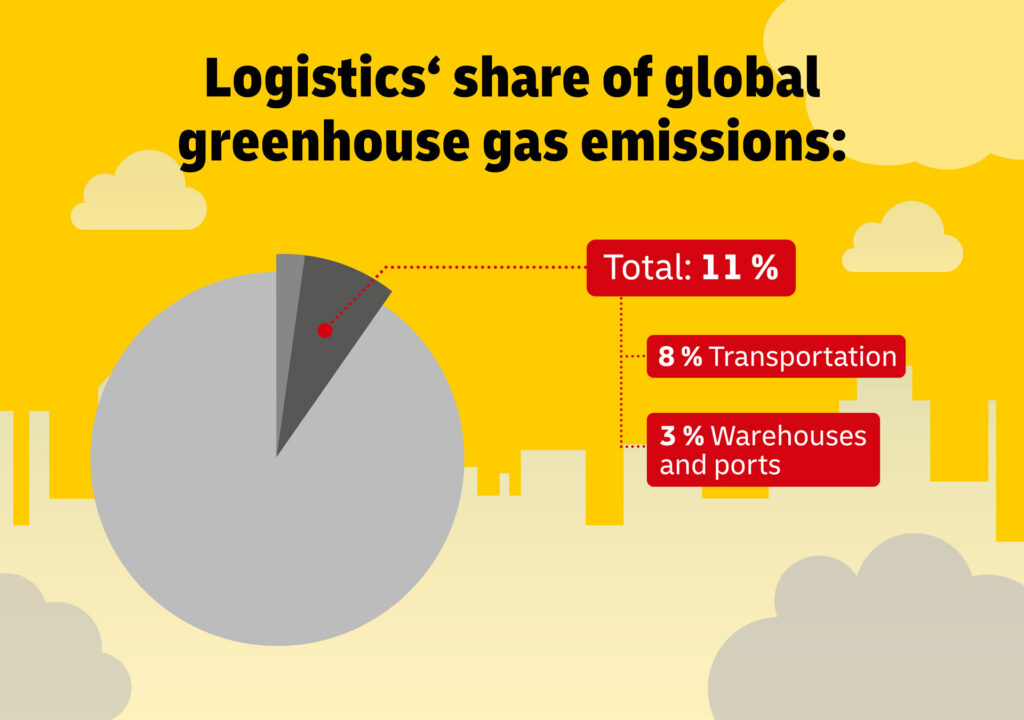
Accordingly, the figures vary depending on the study. The World Economic Forum (WEF) and the Climate Portal estimate that 11% of global greenhouse gas emissions are directly attributable to logistics processes. Of these emissions, 8% are due to transportation and 3% are due to warehousing and ports.
Why Is Reducing Emissions So Important for Transport and Logistics Companies?
Whether it’s 5.5%, 11%, or 15%, the logistics industry contributes significantly to global CO2e emissions. Thus, it is faced with the challenge of substantially reducing its carbon footprint. On the one hand, there is the responsibility for its own economic activity. On the other hand, there are the expectations of corporate customers seeking to reduce Scope 3 emissions via their logistics partners to improve their own ecological balance.
Additionally, many market participants are under pressure to take action for achieving national and EU sustainability goals. These targets require a reduction in CO2 emissions from logistics and other industries to promote sustainable development.
However, sustainability presents not only challenges, but also enormous potential – not only for achieving climate targets, but also for improving competitiveness. Corporate customers increasingly expect transparency regarding emissions in their supply chains. Consequently, sustainability criteria will influence the future viability of companies.
First Step: How Do You Calculate CO2 Emissions?
Before a company can take climate protection measures, it must first know its emissions. Without data, everything is based on estimates. This specifically refers to the amount of greenhouse gas emissions caused directly or indirectly by a company’s business activities. In addition to CO2, there are other greenhouse gases. A carbon dioxide equivalent (CO2e) is determined for these gases, which is derived from the global warming potential of carbon dioxide.
Companies can calculate their greenhouse gas emissions using standardized methods. This calculation involves multiplying activity data by emission factors. Activity data may include fuel tank fill-ups or meter readings. Emission factors are scientifically based and defined in standards. The Corporate Standard of the Greenhouse Gas Protocol is the most widely used standard for greenhouse gas accounting worldwide.
Carbon Accounting for Scope 1, 2, and 3 Emissions
The first step towards reducing a company’s carbon footprint is to measure its greenhouse gas emissions. Although companies are not ...

How Can CO2 Emissions from Transport Logistics Be Reduced?
In addition to technical energy-saving solutions, operational efficiency is key to making processes and companies more sustainable. Greater efficiency means lower resource consumption and a smaller environmental footprint. For instance, optimized routes and more efficient use of loading space reduce fuel consumption and emissions per unit transported.
Thus, key measures for CO2 reduction in transport logistics are:
- Digital route planning with AI support
- Smart load building
- Consolidated shipment: Consolidation of smaller shipments (LTL) into a larger transport unit (FTL)
Since rail freight has a better cargo-to-energy ratio than road freight, intermodal transport concepts that incorporate rail, if available, are an effective way to reduce emissions.

How Can CO2 Emissions Be Reduced Directly During Transport by Truck?
Smart route and load planning forms the foundation of sustainable road freight. Technological solutions can significantly increase this potential. Even diesel trucks can be made more eco-friendly. Keywords here include aerodynamics, speed limiters, low rolling resistance tires, telematics systems, and duo trailers.
The following applies to all types of vehicles: regular maintenance and monitoring, such as checking tire pressure, helps conserve resources. The same applies to sustainable, fuel-efficient driving. Special driver training courses can be useful.
However, to really reduce greenhouse gases efficiently, low-emission fuels and, above all, zero-emission drive technologies are required.
Which Alternative Fuels Can Reduce CO2 Emissions in the Short Term?
Low-emission fuels, such as biodiesel derived from renewable resources, bio-LNG, bio-CNG, and HVO, are promising transitional solutions for reducing emissions in the short term. These alternative fuels are easier to implement than zero-emission solutions because they often only require modifications, rather than the purchase of an entirely new fleet of vehicles.
Which Technologies Make Zero-Emission Road Freight Possible?
Road freight can only be emission-free with electric trucks and hydrogen drives. There are no direct emissions anyway. If the electricity for the drive or the production of hydrogen comes from renewable sources, completely emission-free transport is possible.
Although hydrogen trucks are not yet in regular operation, they are currently in the research, pilot study, and practical testing phase. While they represent a promising solution for the future, it is difficult to estimate when hydrogen technology will be economically viable and reliable.
Are Electric Trucks Already Fit for Heavy Loads and Long Distances?
The situation is different when it comes to electric mobility. Electric delivery vehicles are a common sight in city traffic in many countries. Since they do not cause any direct emissions, they are ideal for last-mile delivery and short-distance transport in urban areas. For these areas, setting up an in-house charging infrastructure on company premises is also relatively easy. The vehicles charge overnight and are ready to go in the morning.
And what about long-distance and heavy-duty transport? Technological development is advancing rapidly, and more and more heavy-duty models with long ranges are entering the market, from both traditional suppliers and start-ups. This challenges the misconception that electric trucks are not suitable for this application.
Is the Charging Infrastructure Keeping Pace with Vehicle Technology?
Limited expansion of charging infrastructure on highways and motorways could be a potential stumbling block. Fortunately, things are starting to happen on Europe’s roads. An interactive map of charging stations for electric trucks, provided by Renault Trucks, illustrates the progress being made.
How Can CO2 Emissions Be Reduced in Warehouses?
Also in the warehouse, the primary lever is efficiency. This can be achieved primarily through automation and smart warehousing systems. Among other things, this involves optimal use of material and space resources, as well as personnel deployment.
Robotics, such as shelf and mobile warehouse robots, speed up processes and contribute to efficiency and sustainability. Modern building technology also plays an important role, from insulation and heating to lighting. Warehouse roofs are often ideal locations for photovoltaic systems, and efficient rainwater utilization is possible in many places.
Whether from your own solar power system or from your energy supplier, the use of renewable energies improves the carbon footprint of logistics processes – both in the warehouse and on the road.
How Effective Is Carbon Offsetting?
It is always better to improve yourself than to compensate for your shortcomings elsewhere. That is why insetting is preferable to offsetting. Through its environmentally friendly core product, GoGreen Plus, DHL Freight invests in sustainable technologies and fuels via carbon insetting, thereby avoiding emissions directly within its own network.
CO2 offsetting with certificates can be a useful supplement to your own efforts. However, it is crucial that the offsetting partners are trustworthy because many offers are considered greenwashing.
It is crucial for greenhouse gas reduction projects to ensure their emission reductions are additional. This means the climate protection measure would not have been implemented without the anticipated revenue from selling the certificates. Other important criteria include transparency, long-term local commitment, reliable monitoring and verification, and external validation.
How Does DHL Freight Reduce CO2 Emissions?
To achieve DHL’s strategic goal of reducing all logistics-related emissions to net zero by 2050, DHL Freight is pursuing an innovative, multi-pronged, technology-neutral approach to operating more sustainably.
Whenever possible, we opt for intermodal transport solutions. We have also developed our own route planning tool, RAPTOR. In vehicle technology, we use alternative fuels to reduce CO₂ emissions immediately. Examples include the first international biodiesel route for transporting medicine and HVO transports for the Manitou Group and Alexion.
In the important field of electric trucks, we believe in the future of battery-powered vehicles for long-distance and heavy-duty transportation. For example, electric trucks are already being used for heavy-duty transport in the area around the German city of Aachen.
In terms of hydrogen trucks, we are conducting our own pilot projects, integrating hydrogen-powered trucks into our daily operations. Additionally, DHL Freight participates in research projects and field studies, such as HyCET and H2Haul.
Our logistics centers are equipped with state-of-the-art storage systems and technology. One example is the robot EffiBOT, which follows employees around and carries loads. DHL Freight also maximizes the ecological potential of its buildings and operating technology. The company incorporates energy efficiency into the design of new facilities, such as the Berlin-Marienfelde terminal.
Sustainable into the Future – with DHL Freight
Transport and logistics account for a significant share of global CO2e emissions. The logistics industry is facing what is perhaps its greatest challenge: to reduce emissions as much as possible through eco-friendly practices. In this time of change, DHL Freight is leading the way in sustainable logistics.
Check out our DHL Freight Green Technology Roadmap to discover how we are working with you to make road freight more sustainable.
Conclusion: Why Are Measures to Reduce CO2 Emissions an Investment in the Future?
The path to low-emission, sustainable logistics demands a holistic view of individual processes, including vehicle fleets, route and load planning, and warehouse management. While some adjustments can be made without significant investment, others require financial commitment.
Sustainable vehicles and technology, modern digital platforms, and AI-supported optimization tools: decarbonizing logistics will undoubtedly incur costs in the beginning. However, companies that adopt these concepts and solutions early on will gain a long-term competitive advantage.
DHL Freight is happy to advise its customers and business partners on all matters relating to sustainable logistics. Get in touch with us!
FAQs on CO2 Emissions and Their Reduction in Transport
1. How can CO2 emissions from road freight transport be calculated in concrete terms?
CO₂ emissions are calculated by multiplying activity data with emission factors. Activity data includes, for example, fuel tank fillings or meter readings. The emission factors can be found in scientifically based standards. The worldwide standard most commonly used for greenhouse gas accounting is the Corporate Standard of the Greenhouse Gas Protocol.
2. Which CO2 reduction measures in transport can be implemented immediately?
Smart route and load planning immediately reduces emissions by shortening trips or reducing their number. Even diesel trucks can be optimized ecologically with aerodynamic trailers, speed limiters, low rolling resistance tires, or telematics systems. Sustainable, fuel-efficient driving also saves CO₂.
3. What role do alternative fuels such as HVO, bio-CNG/LNG, or hydrogen play?
Low-emission fuels such as bio-LNG, bio-CNG, and HVO are good transitional solutions because they are easy to implement and immediately reduce CO₂ emissions. Hydrogen trucks are a promising solution for the future but are currently still in the research and testing phase. If the hydrogen is obtained from renewable energies, hydrogen trucks can be operated without producing any emissions.
4. Are electric trucks already a realistic option for long-distance transport?
Many current electric truck models have a range of over 500 kilometers. Vehicle technology is constantly improving, and there are plenty of models available from established manufacturers and start-ups for long-distance transport. Although the development of charging infrastructure on highways is progressing, it needs to be accelerated further.
5. Is CO2 compensation worthwhile, or should the focus be on avoiding emissions?
Taking your own initiative is better than offsetting. Offsetting CO₂ emissions through certificates is useful as a supplement to your own reduction efforts. It is important that the projects ensure that their emission reductions would not have taken place without the sale of certificates, and that transparency, long-term commitment, monitoring, verification, and external validation are guaranteed.