The first step towards reducing a company’s carbon footprint is to measure its greenhouse gas emissions. Although companies are not directly responsible for these emissions, they should recognise their importance. These emissions often account for a significant proportion of a company’s overall carbon footprint. What is important when it comes to carbon footprint accounting? Who is required to report, and what tools are available?
Why Carbon Accounting Matters
Through the EU Climate Law, the European Union aims to achieve net-zero greenhouse gas (GHG) emissions by 2050. Some member states have set even more ambitious targets. Germany, for example, which has the largest economy in Europe, aims to achieve net-zero emissions by 2045. Finland, with a much smaller economy, aims to achieve this even sooner, by 2035.
Furthermore, an increasing number of companies are establishing their own climate goals. Those that are not setting their own targets may be affected by the goals of companies they cooperate with. Since all emissions in the value chain are important for achieving climate targets, including indirect emissions, many companies must reduce their GHG emissions if they are to continue their partnerships. Large companies in particular are increasingly demanding information about their partners’ and suppliers’ GHG emissions and setting limits.
Without accounting, it is impossible to determine whether limits are being adhered to or climate goals are being achieved. A climate target without climate accounting is meaningless, just like a new record that no one knows about.
What Is Carbon Accounting?
A corporate carbon footprint (CCF) is the total amount of GHG emissions caused by a company’s business activities, whether directly or indirectly. The carbon footprint of a product or service’s life cycle is called the product carbon footprint (PCF). CO₂ accounting determines these footprints, which provide the basis for setting emission reduction targets.
Although we usually talk about the carbon footprint, which refers to the balance of carbon dioxide, CO₂ is not the only human-caused GHG, though it is the most widespread. A carbon dioxide equivalent (CO₂e) is determined for all other relevant GHGs based on the GHG potential of carbon dioxide. This makes it easier to compare GHG balances.
Global warming potential (GWP) indicates how much a given amount of a GHG contributes to global warming compared to the same amount of CO₂. The greater a gas’s GWP, the greater its contribution to the greenhouse effect. For example, methane is more than 25 times more potent than carbon dioxide as a GHG and therefore has a high CO₂e.
Which Greenhouse Gases Contribute to Climate Balance?
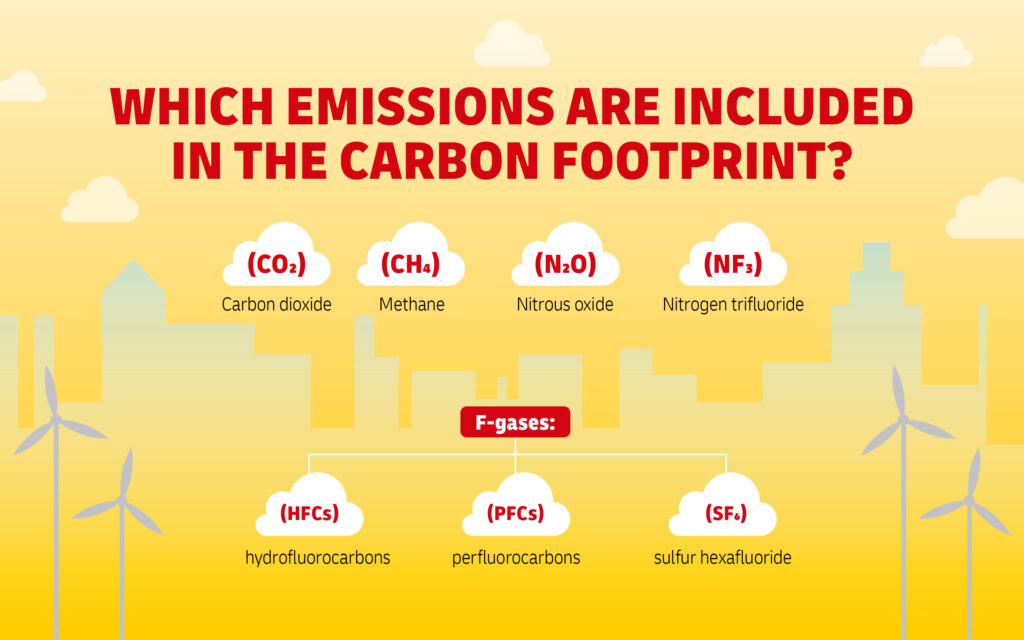
Data on the total direct and indirect emissions of the six most significant types of GHGs are documented, each with its respective CO₂e effect.
- Carbon dioxide (CO2)
- Methane (CH4)
- Nitrous oxide (N2O, commonly known as laughing gas)
- Fluorinated greenhouse gases (F-gases): hydrofluorocarbons (HFCs), perfluorocarbons (PFCs), and sulfur hexafluoride (SF6)
- Nitrogen trifluoride (NF3)
CO₂ emissions dominate in the EU-27, accounting for approximately 80 percent. Methane and nitrous oxide emissions each account for approximately 12 percent, while emissions from the F-gas group total 2 percent.
Scope 1, Scope 2, and Scope 3 Calculation Guidance
Companies can use standardized methods to simplify the process of calculating GHG emissions. Carbon accounting determines the amount of GHGs released based on activity data, such as the fuel consumption of company vehicles or the energy consumption of a building. This data may include tank fillings, electricity and gas meter readings, or kilometers flown. The calculation involves multiplying the activity data by scientifically valid emission factors defined in the standards.
Carbon Accounting Methods
The Greenhouse Gas Protocol (GHG Protocol) is the most widely used model for calculating GHG emissions worldwide. The GHG Protocol Corporate Standard offers comprehensive, standardized guidelines for measuring and managing these emissions. This standard is available online for free.
There are also national standards. In Germany, for instance, many companies use the DIN ISO 14064-1 standard. This standard provides guidance on quantifying and reporting GHG emissions. This standard is subject to a fee, but includes a standardized assessment and certification of the specified CCF by an independent organization.
What Are the Differences Between the Scopes?
The GHG Protocol categorizes GHG emissions into three groups, known as scopes. These scopes classify the various types of GHG emissions a company causes throughout its entire value chain. This scope classification is also used independently of the GHG Protocol.
- Scope 1 emissions: all direct emissions from the company’s own sources, such as those caused by the company fleet or production processes
- Scope 2 emissions: indirect emissions from the consumption of purchased electricity, heat, cooling, or steam for the company’s internal use
- Scope 3 emissions: indirect emissions that lie outside the scope of a company’s activities and are therefore beyond its direct influence. These emissions occur in upstream and downstream processes along the value chain.
Steps Involved in Climate Accounting
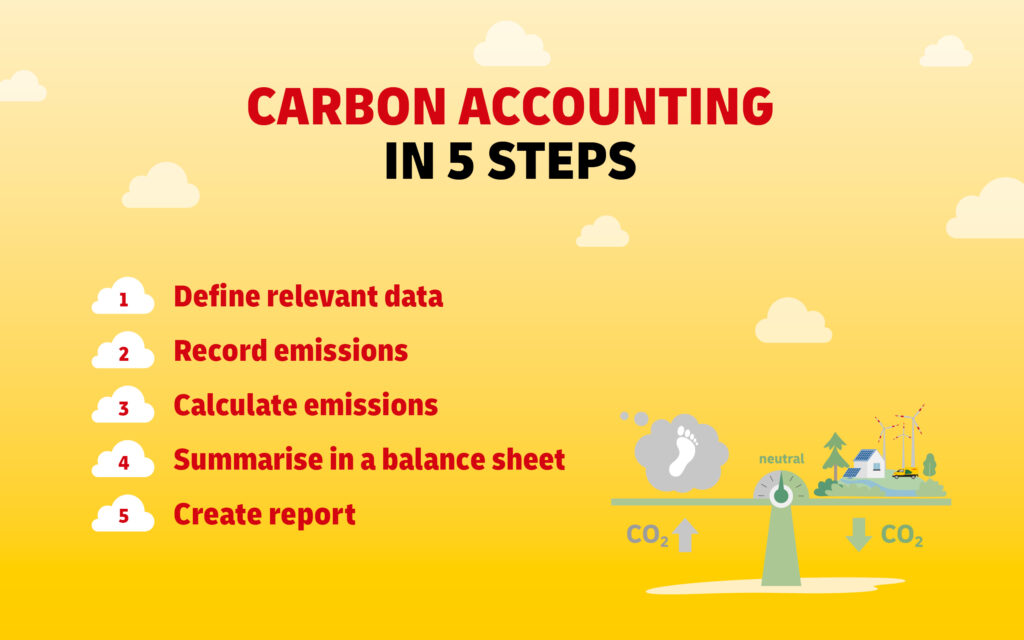
- Definition of the data pool: First, the activities to be included in the carbon accounting must be determined. Should Scope 1 and 2 only be considered, or should Scope 3 be included as well?
- Acquisition: The next step is to identify and quantify all sources of GHG emissions. This can be accomplished through measurements, estimates, or data sheets.
- Calculation: For this purpose, standardized emission factors that are available for various emission sources are typically used.
- Compilation: The results of GHG emissions are summarized in a balance sheet, which is commonly divided into Scopes 1, 2, and 3.
- Reporting and analysis: In accordance with regulatory requirements, the results of the accounting are summarized and analyzed in a report. The analysis identifies potential savings to reduce GHG emissions. If the report is to be published, external verification is required.
Tools to Facilitate Greenhouse Gas Accounting
Various technical tools are available to help companies with carbon accounting. These range from free solutions to commercial software from industry giants, as well as from specialized start-ups. Since each solution has its own advantages and disadvantages, careful comparison is essential. One example of a free tool is ecocockpit, which was developed for the state government of North Rhine-Westphalia in Germany. However, large companies are more likely to seek specialized service providers for accounting and reporting.
Carbon Accounting: What Is Mandatory for Companies, and What Is Not?
Few companies are explicitly obliged to report their carbon footprint. More often, reports are necessary to meet overarching requirements. This is particularly the case under the Corporate Sustainability Reporting Directive (CSRD), which took effect in the 2024 reporting year. The directive aims to make sustainability reporting by European companies more transparent and comparable, thereby improving sustainability. You can find out which companies are affected and when in the blog post on the CSRD.
It is important to note that sustainability reports must include a breakdown of the carbon footprint into Scopes 1, 2, and 3. Since the CSRD requires Scope 3 carbon accounting, companies must obtain the necessary information from their partners and suppliers.
Scope 3 Calculation Methodology and Challenges
Scope 1 and Scope 2 emissions are comparatively easy to measure. In contrast, quantifying Scope 3 emissions across the entire value chain is more challenging. Companies that report these emissions are not directly responsible for them and depend on data provided by their partners, suppliers, and logistics service providers. Logistics often accounts for a significant portion of Scope 3 emissions.
The GHG Protocol’s Corporate Value Chain (Scope 3) Accounting and Reporting Standard provides companies with a standardized framework. The standard contains guidelines for data collection, calculation methods, and reporting practices to ensure accurate and consistent reporting of Scope 3 emissions.
Scope 3 Accounting with GoGreen Plus Automated Reporting
The standard’s guidelines help companies determine the full extent of their Scope 3 emissions in the value chain. Nevertheless, Scope 3 emissions are the most challenging aspect of a company’s carbon footprint.
At DHL Freight, we understand how important logistics-related Scope 3 emissions are to the CCF, as well as how complex it is to account for them. That’s why we developed GoGreen Plus Automated Reporting.
GoGreen Plus automated reporting makes calculating your carbon footprint easier. GoGreen Plus customers receive the report automatically. Companies gain comprehensive insight into their Scope 3 emissions from logistics. They learn when and where these emissions were generated, as well as how much they have saved compared to conventional transport methods. This allows companies to determine the extent to which GoGreen Plus services contribute to reducing their value chain’s overall CO2e footprint.
How You Can Benefit from GoGreen Plus
Climate change is the greatest challenge of our time – and it affects all of us. However, it is not equally easy for every industry and every company to reduce their respective ecological footprint. With GoGreen Plus, we offer you the opportunity to reduce emissions in a simple way thanks to insetting – exactly where they occur. Your investment goes 100% into the use of green technologies within our network.
DHL Freight Services Reduce Scope 3 Emissions
Sustainable logistics services are one of the most effective ways to reduce Scope 3 emissions. DHL Freight’s GoGreen solutions can significantly improve a company’s carbon footprint. Additional costs from GoGreen Plus services are invested entirely and directly in green technologies, which immediately reduces our customers’ CCF.