Artificial intelligence has long since moved beyond merely analysing data – now it plans, coordinates, and increasingly makes decisions independently. This is one of the key findings of the new DHL Logistics Trend Radar 8.0. Here, we present the most important trends and explain their implications for supply chains and road freight.
What is the DHL Logistics Trend Radar?
The DHL Logistics Trend Radar is the DHL Group’s trend research tool. It is developed by DHL Customer Solutions & Innovation (CSI), in collaboration with business, technology and science experts. A new edition is published every two years – 2026 marks the eighth edition.
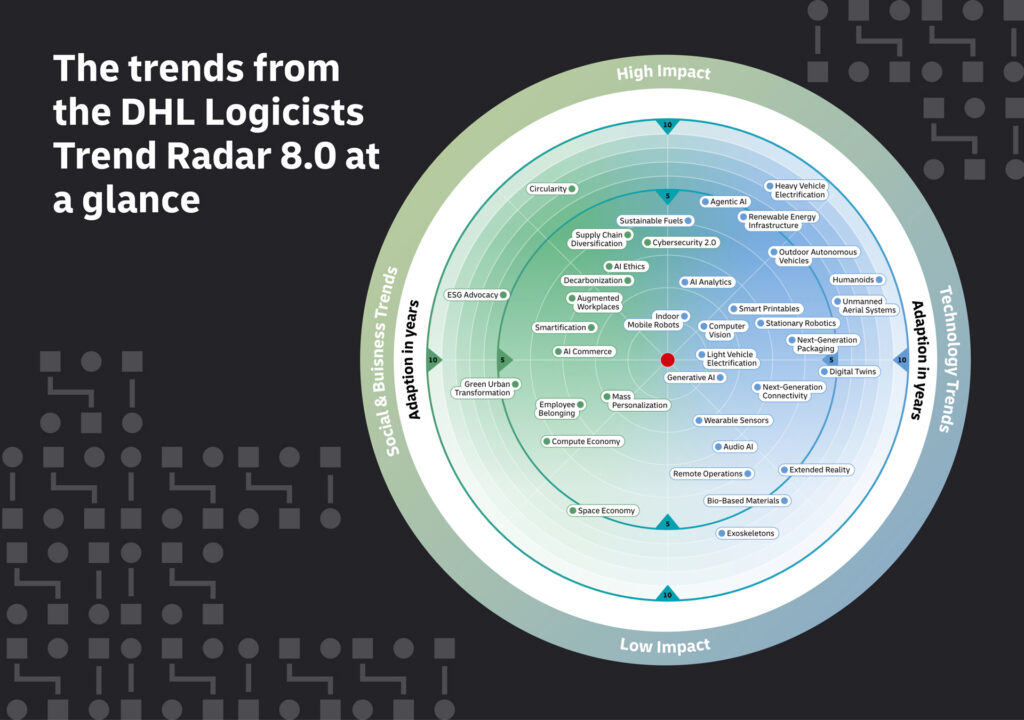
The Radar evaluates technological, social, and economic developments based on their potential impact on logistics and their likely timeframe for becoming relevant. It looks ahead ten years. This provides guidance on which topics deserve attention today and which should rather be monitored in the long term.
Katja Busch, DHL’s Chief Commercial Officer and Head of CSI, believes that speed is the key factor in determining who will benefit from the transformation.
The organizations that succeed will be those that understand these shifts early and are able to turn them into practical advantages for their business and their people. The Trend Radar helps them focus on the developments that will matter most.
Katja Busch
CCO & Head of CSI
Which trends have the biggest impact on logistics?
Of the many developments evaluated, the report highlights ten trends that are considered to have the greatest potential impact over the next ten years. The weighting is striking: four of the trends relate directly to artificial intelligence, while two each focus on the work environment, security and resilience, and reducing emissions.
| Trend | What is it about? | Topic |
| Agentic AI | AI systems that autonomously plan tasks, make decisions, and carry them out – under human supervision | Artificial intelligence |
| AI analytics | AI-powered analysis of large datasets to early identify risks and improve forecasts | Artificial intelligence |
| Generative AI | AI that generates content, analyses, and new digital applications | Artificial intelligence |
| AI ethics | Principles and rules for the transparent, responsible, and compliant use of AI | Artificial intelligence |
| Augmented workplace | Technologies that support employees on the job and enhance safety as well as productivity | Working environment |
| Employee belonging | Workspaces where employees feel they belong, are valued, and have the autonomy to act | Working environment |
| Cybersecurity 2.0 | Advanced security strategies for data, IT systems, and networked supply chains | Security and resilience |
| Supply chain diversification | Diversify suppliers, transportation routes, and networks to mitigate disruptions | Security and resilience |
| Decarbonization | Measures to reduce greenhouse gas emissions in transportation and logistics | Emissions reduction |
| Alternative fuels | Scaling up alternative fuels to reduce emissions in the transport sector | Emissions reduction |
Taken together, a clear picture emerges. AI is taking centre stage in logistics. However, whether AI will fulfil its true potential depends on the people who work with it, and on reliable guidelines for its use.
What’s new in the Trend Radar 8.0?
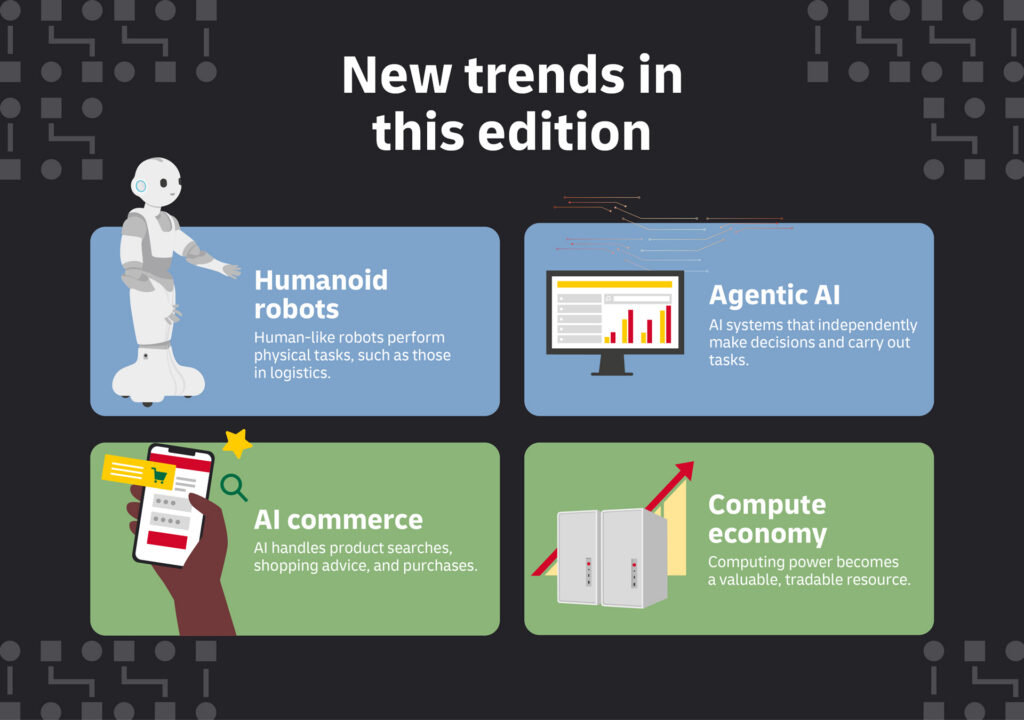
The focus has shifted since the previous edition. The 2024 DHL Logistics Trend Radar 7.0 highlighted AI and sustainability as the most important growth drivers. The eighth edition now focuses on AI alongside changes in the work environment, with sustainability remaining a constant theme. The following four trends are featured in the Radar for the first time:
- Agentic AI: AI agents that make recommendations and act autonomously. The report ranks these agents among the most impactful trends in the entire issue.
- AI commerce: AI is transforming the way consumers and business customers discover, compare, and purchase products. This is also likely to impact ordering patterns and logistics interface requirements.
- Compute economy: Computing power is becoming a strategic resource. Setting up data centres presents its own logistical challenges, such as transporting high-value, sensitive equipment.
- Humanoids: Human-like robots that can move around work spaces designed for humans. The Radar classifies this as a long-term trend.
If AI can analyze and act – what will change?
The common theme of the eighth issue is the transition from supportive to active AI. Previous applications mostly responded to requests or processed information, but the decision ultimately remained with humans. The next stage involves systems that take action on their own. Two trends are at the center of this development.
Agentic AI: How do AI agents work in the supply chain?
Agentic AI refers to AI systems that autonomously pursue a specific objective. Rather than responding to a single request, an AI agent breaks down the task into sub-steps, gathers information, weighs options, and implements actions. Humans remain in charge, defining the framework, monitoring the results, and intervening when necessary.
This concept can be illustrated in the context of road freight. If a road is fully closed on the planned route, for instance, an agent could explore alternatives, assess the impact on agreed-upon time windows, and notify affected customers in advance. The dispatch department can then make decisions based on significantly better information or allow routine decisions to be handled automatically within clearly defined limits.
AI Analytics: How does AI detect faults before they occur?
AI analytics uses AI-powered analysis to identify patterns in large data sets, forecast trends, and derive concrete recommendations for action. The main differences from traditional analyses are speed and scope. Combining AI Analytics with Agentic AI results in supply chains that can increasingly adapt to changing conditions on their own.
The report identifies several potential fields of application that are likely to become reality in the future:
- Identifying potential inventory shortages early on
- Automatically rerouting shipments in the event of disruptions
- Adjusting transport capacities according to demand in real time
Klaus Dohrmann, Vice President Innovation and Trend Research, DHL Customer Solutions & Innovation, characterizes this leap in development as follows:
Until now, AI has helped people perform tasks more efficiently. The next chapter is about action. We’re entering an era of autonomous and physical AI, where intelligent systems can actively perceive the world, navigate complex environments, and make decisions with minimal human intervention.
Klaus Dohrmann
VP Innovation & Trend Research CSI
What role will people play in tomorrow’s logistics?
In addition to technology, the report focuses explicitly on the work environment. The report’s central thesis is that technology complements, rather than replaces, employees’ skills. However, for this to succeed, companies must invest in targeted training and good working conditions.
Augmented Workplace: which technologies support employees?
The Radar compiles technologies that support people in their work under the term “augmented workplace”. These include the following:
- Wearables and sensor technology: wearable systems that track, for example, movement patterns or physical strain and can thus contribute to greater workplace safety.
- Exoskeleton: mechanical support structures that facilitate physically demanding activities such as lifting and carrying.
- Collaborative robots (cobots): robots that work right alongside people, performing repetitive tasks.
- Remote operations: remote control and monitoring of systems, machines, or vehicles.
- AI assistants in the workplace: Digital aides that consolidate information and provide recommendations for decision-making in day-to-day work.
The goal is to create a safer, more productive, and more appealing work environment. When technology takes over monotonous tasks, employees have more time for activities that require human expertise, such as solving problems, serving customers, and managing processes.
Why is employee belonging important during times of change?
The report assumes that AI, automation, and robotics will transform hundreds of job profiles, including operational, technical, and knowledge-based professions. These changes will increase the demand for certain skills and work methods. Therefore, it is not enough for managers to simply introduce new systems.
It is crucial that employees have the necessary knowledge and trust the technology, as well as have the support of their team. This is precisely where employee belonging comes into play. Employees who feel a sense of belonging and are valued within the company are more likely to actively engage in change processes. Thomas Ogilvie, Chief Human Resources Officer and Labor Director at DHL Group, states: “People remain the driving force behind every successful supply chain.“
The future of logistics will not be determined by the question of humans or AI, but by how well companies combine human expertise with increasingly powerful technologies.
Thomas Ogilvie
Chief Human Resources Officer and Labor Director at DHL Group
Why are AI ethics and Cybersecurity 2.0 becoming increasingly important?
As AI systems assume more responsibility, the requirements for their use increase. When algorithms handle demand forecasting, inventory planning, or transport decisions, the results must be transparent and reliable. The Radar highlights two trends that aim to balance innovation and control:
- AI ethics: clear rules governing the use of AI – transparently, fairly, and in accordance with legal requirements such as the EU AI Act. This also includes determining where humans have the final say.
- Cybersecurity 2.0: advanced security concepts for a logistics sector in which an increasing number of systems, vehicles, and partners are digitally interconnected. Every new interface is a potential point of attack and must be protected accordingly.
The report’s message is clear: safeguards and human oversight do not stifle innovation. Rather, they are essential for companies to entrust critical processes to autonomous systems.
What roles do sustainability and resilience play?
As in previous editions, sustainability remains a key driver of innovation. Another issue that has been a concern for supply chains for years is the ability to mitigate disruptions. These two aspects are both featured prominently in Trend Radar 8.0.
How are decarbonization and alternative fuels changing transportation?
Decarbonization and alternative fuels – two trends directly related to reducing emissions, rank among the top ten trends. Additionally, the Radar monitors the circular economy and the electrification of light- and heavy-duty commercial vehicles.
All of these trends share the objective of aligning supply chains with resource efficiency and reuse, thus reducing CO₂ emissions. Two developments are particularly evident in road freight: First, alternative fuels, such as HVO, can be used in existing diesel trucks. By contrast, the electrification of heavy-duty commercial vehicles requires new vehicles, a suitable charging infrastructure, and adapted operational planning.
Why is diversifying the supply chain becoming more important?
Supply chains depending on a small number of suppliers, routes, or hubs are vulnerable. If just one link fails, the entire chain can quickly grind to a halt. Thus, diversification of the supply chain requires a broader range of options – in terms of sourcing, as well as transportation routes and networks.
For shippers, having planned for alternatives means they can switch over more quickly in the event of a disruption. A dense, cross-border road network is key here because it enables flexible routes and capacity on short notice.
What do these trends imply for DHL Freight and road freight?
The Trend Radar provides a holistic view of logistics. For us, as specialists in European road freight transport, several of these trends are already becoming a reality in our daily operations. At DHL Freight, we primarily integrate them into our solutions in three areas:
- Data and AI: We closely monitor developments in agentic AI and AI analytics, assessing where data-driven applications create real added value. For example, these applications can be used to plan transportation processes more proactively or respond more quickly to disruptions. Our guiding principle is this: AI supports decision-making, but humans remain responsible.
- Digital interfaces: With myDHLFreight, customers can book and track shipments online. Such digital processes form the data foundation on which AI-powered applications will be built in the future.
- Emissions reduction: With GoGreen Plus, we give customers the chance to lower their CO₂e emissions from road transport by using alternative fuels.
The report’s key message also applies to road freight: technology reaches its full potential only through the people who use it. Drivers, dispatchers, and terminal teams contribute valuable experience and judgment that cannot be replaced by software. Nonetheless, digital tools can alleviate some of their pressure.
DHL Logistics Trend Radar 8.0
You will find all the trends, their analyses, and detailed background information in the full report from DHL Customer Solutions & Innovation.
Outlook: Why AI and humans both belong in logistics
The DHL Logistics Trend Radar 8.0 indicates a turning point. AI is evolving from a mere tool to a pivotal player in the supply chain. Agentic AI and AI analytics are making supply chains faster, more proactive, and more adaptable. However, the report also shows that this progress will only be successful if companies establish clear rules, effective safeguards, and qualified teams.
Notably, the Radar integrates two perspectives that are often discussed separately. This eighth edition gives equal weight to technology and the working environment. Added to this are emissions reduction and resilience, which must be considered alongside every new technology as ongoing priorities.
The Radar thus provides forwarders and logistics managers with a solid foundation for setting priorities for the coming years. Would you like to know how these trends will affect your European road freight operations? Contact us!