No other mode of transportation is as prominent as a truck on the highway – and no other is subject to such sweeping judgments. Many assumptions about road freight transport date back to a time when they may have been true: the era of all-diesel fleets, paper-based systems, and a profession in decline.
However, the industry has undergone profound changes since then. We debunk the seven most common prejudices and reveal what today’s modern road transport actually looks like.
Prejudice 1:
Is Road Freight Really that Bad for the Climate?
Perhaps the most persistent prejudice is that road transport as such is inherently harmful to the climate. While it is true that diesel continues to dominate the European road freight industry, it is wrong to suggest that the industry has simply accepted this and is not doing anything about it.

DHL Freight intends to reduce all logistics-related emissions to net zero by 2050 – and is investing heavily in alternative propulsion systems to achieve this goal.
Low-emission drives are a short-term solution: In combustion engines, CO₂ emissions can be significantly reduced today through the use of renewable fuels.
- Biodiesel: For the first international biodiesel route for the transport of medicines, DHL Freight is using fuel made from organic waste materials for Lilly.
- Hydrogenated vegetable (HVO): HVO-powered trucks are on the road for the Manitou Group and Alexion, among others. HVO is a fuel that can be used without engine modifications and that significantly improves the carbon footprint of each route.
- Bio-CNG and Bio-LNG: Gas-powered vehicles are only ecologically effective when they run on biogas instead of fossil natural gas.
- Synthetic fuels / e-fuels: They are strategically valuable if produced using renewable electricity.
Drive systems with the potential for zero emissions in the future: Truck propulsion can be completely emission-free with electric mobility and hydrogen – provided the electricity and hydrogen come from renewable sources.
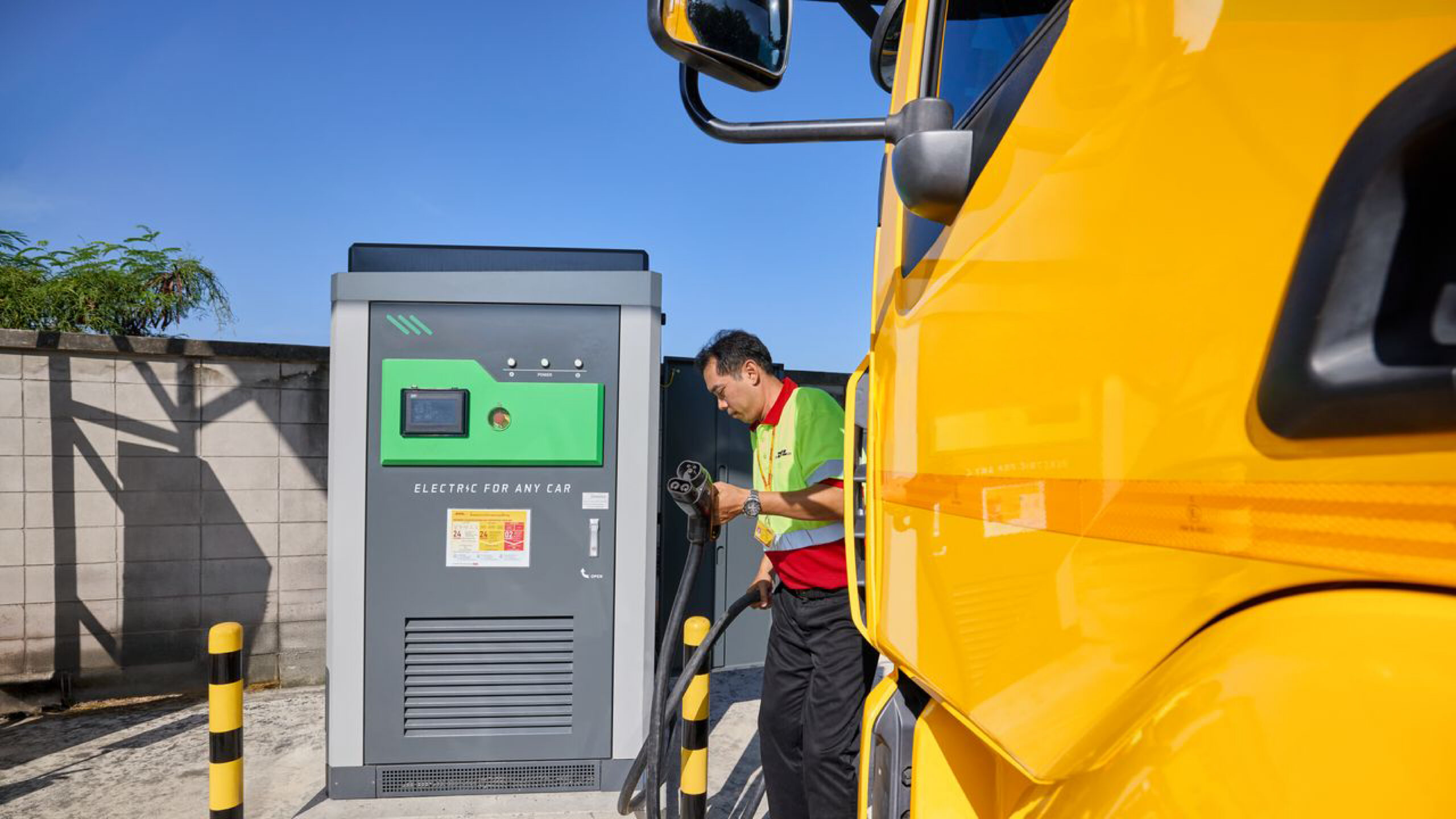
- Electric trucks: Long-established in last-mile and local delivery services, DHL Freight has expanded into long-haul and heavy-haul transport. DHL Freight uses electric trucks for regular routes with Hilti and Satair, as well as for deliveries in southern Sweden with Falkenklev and heavy-haul transport in the area around Aachen in Germany. DHL Freight is also testing innovative vehicles in real-world conditions, such as the eTopas 600 from SuperPanther.
- Hydrogen-powered trucks: In addition to its own pilot operations, DHL Freight participates in research projects, such as HyCET, and large-scale field studies, such as H2Haul. These are two of the most ambitious initiatives currently underway for hydrogen in heavy-duty transport.
Contrary to popular belief, road freight is not resistant to change. In fact, it is one of the most dynamic areas of experimentation in the transition to sustainable transport.
Emission-reduced Trucks: How DHL Freight Is Setting Milestones
DHL Freight is committed to reducing all logistics-related emissions to net zero by 2050. Emission-reduced trucks are a key part ...

Prejudice 2:
Is Rail Always Superior to Trucking?
A common belief goes like this: If one is serious about the transportation transition, the focus should be on rail. However, it is not quite that simple.
Rail freight performs best on designated main routes and with large volumes. That said, when it comes to flexibility, coverage, and delivery right to the loading dock, road freight remains the top choice.
Very few companies have a direct rail connection. As a result, rail freight typically begins and ends on the road. Thus, the appropriate question is not „rail or road?“ but rather: “How can these two modes of transport be combined smartly?” In intermodal transport, rail handles the long-haul while trucks cover the pre- and post-carriage – it is a matter of collaboration, not competition.
Prejudice 3:
Are Trucks on the Highway Frequently Empty?
The perception that trucks drive around half-empty persists. In reality, though, the industry has been working for years to reduce empty runs – after all, every unloaded axle is a waste of resources, both economically and environmentally.
Modern route planning consolidates shipments from various sources, and route optimization balances capacity utilization and sequencing. DHL Freight uses RAPTOR, an AI-powered planning solution, to combine shipments into optimal routes in real time.
Additionally, standard network services combine less-than-truckload and consolidated shipments, eliminating the need for a separate truck for each customer. The result is higher capacity utilization, fewer miles per shipment, and lower emissions per ton-mile.
Prejudice 4:
Is Road Freight a Low-Tech Business?
Rarely does digitization come to mind when people think of road transport. Yet, logistics is one of the most digitized industries, and trucks have long since become mobile data points.
Telematics provides real-time information on location, temperature, and vehicle condition. The AI-powered route planning with RAPTOR calculates optimal routes while factoring in traffic, driving times, and capacity. Digital freight documents (eCMR) replace paper-based documentation. Predictive maintenance identifies technical issues before they lead to breakdowns.

Technological advancements have also greatly impacted the vehicles themselves. Modern trucks are equipped with a variety of driver-assistance systems, including lane departure warning systems, adaptive cruise control, and emergency brake assistants. Concurrently, semi-autonomous and fully autonomous driving functions are being tested in pilot projects to further improve safety and efficiency in heavy-duty transport.
Furthermore, artificial intelligence is playing an increasingly important role in direct customer interactions. Platforms like myDHLFreight provide customers with a single interface for booking, tracking, and billing. DHL Freight also offers a virtual assistant, the AI chatbot VIVA, which independently answers up to 93 percent of all customer inquiries around the clock, including questions about shipment tracking, complaints, and products.
Today, the road freight system is highly interconnected – driven by the demand for speed, transparency, and reliability.
Prejudice 5:
Are Trucks on Our Roads a Security Risk?
Understandably, serious accidents involving trucks dominate public perception, but they distort the overall picture. In fact, the trucking industry has significantly improved road safety in recent years, driven by investments in vehicle technology, regulatory requirements, and training standards.
The revised EU General Safety Regulation (GSR) requires that all new trucks registered in the EU since July 2024 be equipped with more than ten mandatory driver assistance systems.
These include, among others, emergency brake assistants, lane departure warning systems, driver drowsiness detection systems, turn-assist systems, and intelligent speed assistance. These systems are designed to protect cyclists, pedestrians, and other traffic participants. As a result, all new trucks registered today come standard with safety technology that, just a few years ago, was only available in luxury vehicles.
Professional fleets go beyond regulatory requirements and invest in safety. They use telematics to monitor driving behavior in real time and provide regular training to keep drivers up to date. They also invest in new generations of vehicles that improve the driver’s direct view from the cab. These measures are key to protecting vulnerable road users.
The rationale is obvious: the larger the vehicle, the greater the responsibility. This is precisely why road freight is one of the most regulated and technologically advanced mobility sectors.
Prejudice 6:
Is the Profession of Truck Driving Becoming Obsolete?
The cliché of the lonesome truck driver on endless highways is hard to shake, but it no longer reflects today’s reality. The profession has changed tremendously.
Modern cabs feature ergonomic seats, high-quality climate control, comfortable sleeping areas, and digital assistance systems that range from route management to billing.
The training program is well-structured, and advanced training opportunities include specializations such as handling dangerous materials and operating heavy-haul vehicles. Due to the Europe-wide shortage of drivers, prospects in the job market have improved significantly.
Furthermore, this profession is systemically relevant. Without truck drivers, production, trade, and supply chains would come to a halt. Few other professions are so directly linked to the functioning of society.
Prejudice 7:
Is Road Freight the Weakest Link in the Supply Chain?
Traffic jams, delays at loading docks, or late deliveries – anyone affected by these issues likely remembers them for a long time. Fortunately, modern road freight is based on measurable quality, which helps address these issues.
Punctuality is tracked as a KPI, and deviations are systematically analyzed and incorporated into the continuous improvement process. Real-time tracking provides everybody – senders, recipients, and dispatchers – with transparency regarding the status of every shipment.
DHL Freight emphasizes its commitment to quality by offering a money-back guarantee for Road Freight Priority. Customers receive a refund if the shipment does not arrive on time (this applies only to contracts effective April 15, 2026). A company only makes such a promise if its underlying processes are robust.
How Has Road Freight Changed in Recent Years?
When considered together, these seven points reveal a pattern: today’s road freight is nothing like it was ten years ago. Three trends are shaping this transformation.
Propulsion transition: Electric trucks, hydrogen pilots, HVO, and biogas are no longer just ideas for the future; they are already being used in customer projects.
Digitalization: The industry has fully embraced the digital age, from IoT-connected vehicles and AI-powered route planning to fully digital shipment processing.
Professionalization: The level of safety technology, quality KPIs, training standards, and binding service commitments has reached a point where the notion of “simple transportation” is no longer applicable.
These developments are occurring simultaneously – and they reinforce each other.
What Is DHL Freight’s Approach to Modern Road Transport?
DHL Freight has addressed these seven prejudices with specific products and projects. Road Freight Standard combines less-than-truckload and consolidated freight shipments across Europe, ensuring high utilization rates. Road Freight Priority offers time-definite delivery with a money-back guarantee. Road Freight Direct covers full truckload shipments and direct transport.
From a technological perspective, RAPTOR is an AI-powered route and transport planner, while myDHLFreight provides a digital customer platform for booking, tracking, and billing.
In terms of reducing emissions, GoGreen Plus offers solutions for customers who want to reduce their carbon footprint through the use of alternative fuels or insetting for their transportation needs. These offerings are complemented by pilot and research projects, such as HyCET and H2Haul, which focus on hydrogen. There are also specific customer routes that use electric trucks, HVO, and biodiesel.
The goal is to reorganize road freight, ensuring that none of the seven prejudices hold true.
Conclusion: Do the Prejudices about Road Freight Contain a Grain of Truth?
Many of the common prejudices about road freight arose for a reason – they reflect the industry of the past. Today’s road freight business looks different. Companies are testing hydrogen and are running on HVO and biodiesel. Additionally, they use AI for planning, measure quality through KPIs, and train professional drivers.
This does not mean that everything has completely been resolved. The transition to zero-emission propulsion systems is a multi-year process, and infrastructure and cost issues remain challenging. However, the path is clear, and we are heading in the right direction.
For companies that rely on road transport for their supply chains, it is worth taking a closer look. What solutions are currently available? Which partners are driving this development forward? Contact us, and we will show you how modern road freight can benefit your company.
FAQs on the Common Prejudices about Road Freight
What is meant by road freight transport?
Road freight transport involves moving goods via roads using trucks, vans, and other types of commercial vehicles. It is the most widely used mode of transport in European logistics for full and less-than-truckload shipments, as well as general cargo. The strengths of road freight include flexibility, extensive coverage, and direct delivery to the loading dock.
What is the greatest advantage of road freight over other modes of transport?
The key advantage is flexibility. Road freight can reach almost any location in Europe directly without transshipment to rail or waterways. This makes it the top choice for the vast majority of goods, especially for the first and last mile. Even when combined with rail and waterways, trucks remain the mode of transport that completes the network.
What is the role of road freight in the European supply chain?
Road freight is the backbone of the European supply chain. It connects production sites, warehouses, turnover points, and end customers, regardless of industry or shipment size. Without a functioning road transport system, rail, sea, and air freight would be unable to fulfill their roles because nearly every shipment travels by road at least part of the way.
Which goods are best suited for road transport?
Road freight is well-suited for nearly all types of goods, including palletized shipments, temperature-controlled pharmaceuticals, heavy loads, and specialty cargo. It is particularly useful for time-sensitive shipments and deliveries to locations without rail access, as well as for flexible routes. Depending on the volume and time constraints, shipments may be partial or full truckloads (PTL/FTL) or less-than-truckload (LTL).
In which cases is a combination of road and rail more practical than road freight alone?
Intermodal solutions that combine rail and road transport are ideal for long distances with high volumes of freight on well-established routes. Rail handles the main leg of the journey while trucks cover the pre- and post-carriage. This combination is practical when timing allows for it and the infrastructure at both ends is suitable. Intermodal solutions reduce CO₂ emissions per ton-kilometer and ease congestion on heavily traveled main roads.