Few other logistics operations face such tight deadlines as Formula 1. Between race weekends, all the equipment must be moved to the next venue on time and be ready for use. During the 2026 season, it was in this environment that DHL used rail transport for the first time for racing sports logistics – a mode of transport that had long been considered too inflexible for such operations.
On the route from Miami to Montreal, more than two-thirds of the cargo that would have normally been transported by truck reached its destination by rail as part of a pilot test. Thus, the pilot answers a question that extends far beyond motorsports. Is switching to rail transport feasible within tight time frames?
What Did the Pilot Project Between Miami and Montreal Entail?
Over nearly 2,000 kilometers, DHL transported 50 containers of racing equipment from Florida to Canada, including 46 forty-foot high-cube units and four 20-foot containers. This corresponds to a total floor space of 1,148 Euro pallets. Instead of being transported by road, approximately 68% of the freight was shipped via rail.
The outcome: reduced traffic involving high-emission transportation modes without compromising the racing series’ tight schedule. Before the test, it was unclear whether these two goals could be reconciled – and that is precisely where the project’s added value lies.
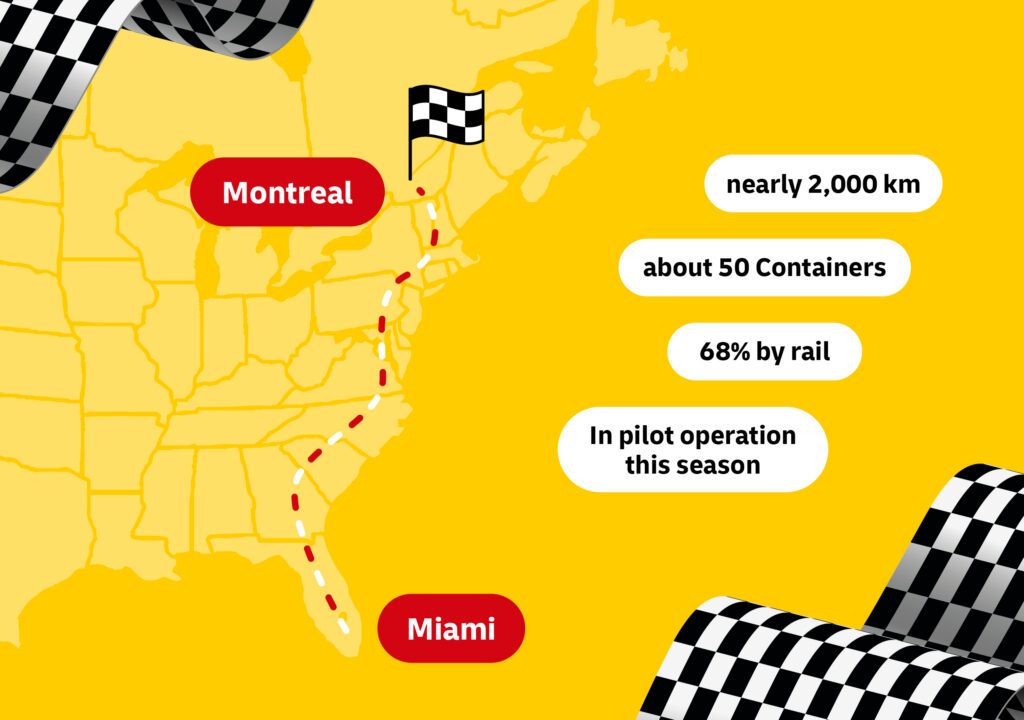
An Overview of the Pilot Project
| Route | Miami (Florida) → Montreal (Kanada) |
| Distance | nearly 2,000 km |
| Load | 50 containers (46 x forty-foot high cube, 4 x twenty-foot) |
| Share of rail transport | about 68% of the freight on this section |
| Time range | 2026 Season, pilot operation |
How Did DHL Ensure On-Time Delivery and Cargo Protection?
Each container was equipped with sensors: tracking devices monitored the containers’ locations in real time, and shock sensors detected impacts and vibrations. Thanks to these features, the team could monitor transit times, handling, and the condition of the sensitive cargo. This ensured that the equipment arrived intact and on schedule.
DHL is using the collected data to develop strategies for potential routine operations. This data is incorporated into assessments of key operational criteria and sustainability performance. In collaboration with Formula 1, the data helps identify additional opportunities to reduce environmental impact.
The successful delivery of all freight in this pilot demonstrates that rail can reliably support Formula 1’s demanding schedule while contributing to lower emissions. This reflects how DHL and Formula 1 continue to evolve logistics solutions to reduce the championship’s environmental footprint, while laying the groundwork to scale new approaches.
Paul Fowler
Head of Global Motorsports Logistics DHL Global Forwarding
What Is the Role of Rail in DHL’s Climate Strategy?
DHL and Formula 1 have been collaborating for over two decades. The rail pilot contributes to the sustainability targets that both partners are pursuing. The racing series aims to achieve net-zero emissions by 2030, and the DHL Group by 2050.
Thus, the rail initiative is part of a series of measures through which DHL is reducing emissions across multiple modes of transportation on the Formula 1 calendar.
- SAF in air freight: sustainable aviation fuel (SAF) is used on select routes, obtained through book-and-claim models. Using this fuel results in up to 80% fewer greenhouse gas emissions over an entire life cycle compared to conventional jet fuel.
- Trucks running on biofuel in Europe: a fleet of over 50 vehicles runs on biofuels, which reduces greenhouse gas emissions by an average of 83% compared to equivalent diesel trucks.
- Shorter tours: closely aligning route planning with the racing calendar and consolidating regions more effectively shortens transport distances and increases capacity utilization throughout the season.
What’s to Expect After 2026?
For both partners, the route between Miami and Montreal shows that rail transport is a viable option within the network. Accordingly, DHL and Formula 1 are exploring ways to increase rail transport usage in North America, starting in 2027.
The scope of this expansion depends on three factors: the schedule of races, practical feasibility at local level, and the results of this year’s trial run.
What Can Be Adapted to Road Freight?
The real value for shippers and logistics managers lies in applying the pilot’s outcome to their own operations. If a modal shift – the transition from road transport to another mode – can be achieved under the extreme time constraints of motorsports, then there are clear implications for the predictable, recurring flows of goods. Reducing CO₂ emissions often requires not new technology but the smart combination of existing modes of transport.
DHL Freight is taking this approach in road freight transport through intermodal solutions and GoGreen Plus, which reduces transport-related emissions through insetting.
An Established Mode of Transport Taking on a New Role
The rail pilot test in North America challenges the common assumption that time-sensitive, high-performance logistics and a shift to rail are incompatible. During a busy season and under real-world conditions, DHL proved the opposite by successfully delivering all items and meeting the schedule.
By doing so, DHL not only added another building block to its net-zero goals, but also gained valuable experience for future routes. The next test will begin in 2027.