New U.S. tariffs, the war with Iran, and the closure of the Strait of Hormuz – the news of recent months might have created the impression that global trade is in retreat. Data from the new DHL Globalization Tracker paints a different picture: global trade in goods is gaining momentum, and globalization is reaching a new peak. We summarize the key findings and examine their implications for companies in Europe.
What is the DHL Globalization Tracker?
The DHL Globalization Tracker concisely covers the current state of globalization and global trade in approximately 20 pages. Published by the DHL Group, the Tracker is authored by Steven A. Altman and Caroline R. Bastian of the NYU Stern School of Business in New York. It provides an accessible summary of the comprehensive DHL Global Connectedness Report.
The October 2026 edition is the first to appear under its new name. Previously, the report was titled “DHL Global Connectedness Tracker”. An interactive data tool on the DHL website accompanies the PDF and allows users to filter charts, figures, and brief explanations by country, region, and time period. Users can also download the data in various formats. Data on trade in goods, foreign investment, and mergers and acquisitions extends to mid-2026, while full-year figures for 2025 are provided for all other types of flows.
Is global trade still growing despite tariffs and conflicts?
Yes, and at a faster pace than at any time in the past 15 years. In the first half of 2026, global trade in goods increased more than in any other six-month period since 2011, except during the unprecedented economic recovery following the COVID-19 downturn. Even in 2025, trade volume experienced its most significant growth since 2017. In short: while the headlines highlight disruptions, the trade data reveal resilience.
The tracker indicates that there are several reasons why higher U.S. tariffs are slowing global trade less than anticipated:
- Limited share: the United States accounted for only 13% of world imports in recent years, and roughly half of U.S. imports were exempt from tariff increases as of August 2026.
- Little retaliation: most countries refrained from imposing retaliatory tariffs. Instead, many opted for new trade agreements with alternative markets.
- Stable regulations: 72% of goods trade is still conducted on most-favored-nation (MFN) terms of the WTO; in other words, without special tariffs for individual partners. In 2022, though, this share was still at 80%.
By contrast, the consequences of the Iran war were significant but geographically limited. Following the outbreak of war in late February 2026, trade volumes across the Middle East and Africa fell sharply. The hardest-hit economies were those dependent on the Strait of Hormuz, as well as sectors involving resources such as oil, gas, and fertilizers.
What role does artificial intelligence play in global trade?
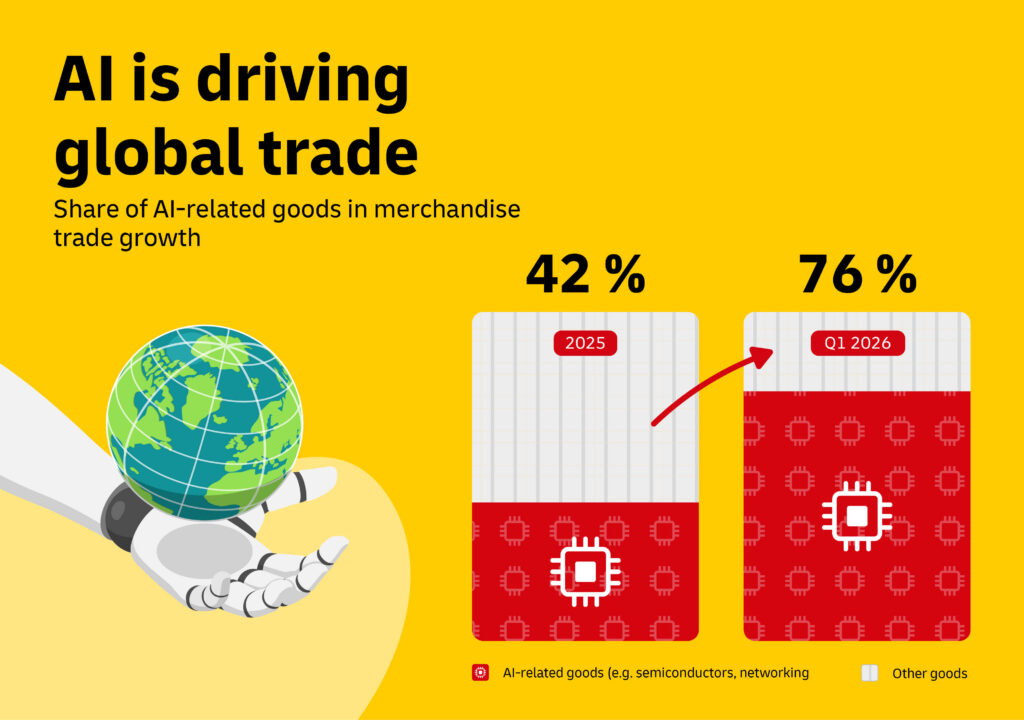
The race to build AI infrastructure has become a major driver of trade growth. AI-enabling goods, such as semiconductors and data transmission equipment, accounted for 42% of all goods trade growth in 2025, and this share rose to about 76% during the first quarter of 2026, according to WTO and OECD research. The value of global trade in these goods grew 22% in 2025 and accelerated to 42% year-on-year in the first quarter of 2026.
The biggest story in global trade right now is AI – not tariffs.
John Pearson
CEO DHL Express
This finding is pivotal for logistics. Chips, servers, and network components are produced within international value chains. Often, raw materials, intermediate products, and finished systems cross multiple borders before reaching a data center. “Every AI query ultimately depends on logistics“, states Pearson. Trade in critical minerals, batteries, and electric vehicles also expanded rapidly during the first quarter of 2026.
Where is trade growing the most?
Growth varies significantly by region. The following overview shows the change in value of trade (in U.S. dollars) from January to May of 2026 compared to the same period the previous year:
| Region or country | Change in value of trade |
| East Asia and the Pacific | +24% |
| Europe | +12% |
| Sub-Saharan Africa | +11% |
| Uzbekistan (strongest growth among the 50 largest trading nations) | +122% |
| Malaysia | +51% |
| Taiwan (China) | +44% |
| Saudi Arabia | −37% |
| Ireland | −16% |
| United Arab Emirates | −7% |
Malaysia and Taiwan are particularly benefiting from the increased demand for electronics used in AI applications. Meanwhile, the Strait of Hormuz closure is impacting Saudi Arabia and the United Arab Emirates. Ireland’s trade is expected to normalize in early 2025 following the frontloading of pharmaceutical exports to the U.S. Among the world’s 100 largest trade routes, exports from Germany to China are also declining in value.
How global is today’s world economy?
The world is more globally connected than ever before – yet still far from complete integration. The DHL Global Connectedness Index measures the flow of trade, capital, information, and people across borders relative to domestic activity. In 2025, this figure reached a new record high of 25.8%. International flows grew faster than domestic flows across all four categories.
Scaled from 0% (no flows cross national borders) to 100% (no border or distance effects), the global figure is at around one-quarter. Information flows are the most globalized, while people flows are the least. In 2025, about 20% of the value of all goods and services produced worldwide was traded internationally, just below the 2008 record high of 22%.
Companies are not withdrawing from foreign markets either. In 2025, foreign direct investment (FDI) increased its share of global investment. The information technology and electronics sector accounted for about 40% of the value of newly announced foreign projects. Additionally, payments for the use of foreign patents and licenses continued to rise.
Is the global economy fragmenting into blocs?
No – at least not yet. The tracker clearly distinguishes between developments occurring between the U.S. and China, and those in the rest of the world: the U.S. and China are decoupling, but the rest of the world is not. On average, China’s share of U.S. trade, capital, information, and people flows has fallen by 48% since 2016, while the U.S. share of China’s flows has fallen by 44%.
For the global economy as a whole, however, this is a minor shift. From January to May 2026, direct trade in goods between the two countries accounted for only 1.6% of global trade, down from a peak of 3.5% in 2015. Cross-border investments between the two countries account for less than 1%.
U.S. allies are maintaining their relations with China.
Most of the United States’ allies, including major European economies, Japan, Australia, and Canada, have largely maintained their economic ties with China. Since 2016, their share of economic activity involving China has declined by only an average of 4%. Besides, the lion’s share of international business already occurs between allied nations. In 2025, trade in goods among close allies was three times greater than trade between rival blocs. For new investments, the figure was eight times higher, and for corporate acquisitions, it was 19 times higher.
Redirected, not disappeared
At first glance, it seems that the U.S.’s dependence on China has decreased drastically. From 2017 to the first five months of 2026, China’s share of U.S. merchandise imports fell from 22% to 7%. Nevertheless, imports from other countries increasingly contain materials and components from China. When these are factored in, dependence has only declined slightly by 2024. Thus, a significant portion of the trade relationship is simply taking a detour through third countries.
Is global trade becoming more regionalized?
For the first time, there are solid indications of this, albeit only within the trade of goods for now. On average, trade flows increased in distance until 2024. In 2025, regionalization saw a slight increase, followed by a more significant shift during the first five months of 2026.
East Asia & Pacific was the main driver of trade regionalization: the average distance for goods trade in the region declined by 201 kilometers, while the intraregional share rose from 57% to 60%. According to the authors, this could reflect intra-Asian supply chains boosted by the AI boom. North America moved in the opposite direction. Its average trade distance increased by 140 kilometers because U.S. trade with distant partners, such as Taiwan, Vietnam, and South Korea, expanded. Meanwhile, average trade distances in Europe have shortened slightly.
This trend is not evident in investments. That said, regionality has long been the norm here. Around half of all international investments take place within regions roughly the size of a continent.
What is the outlook until 2029?
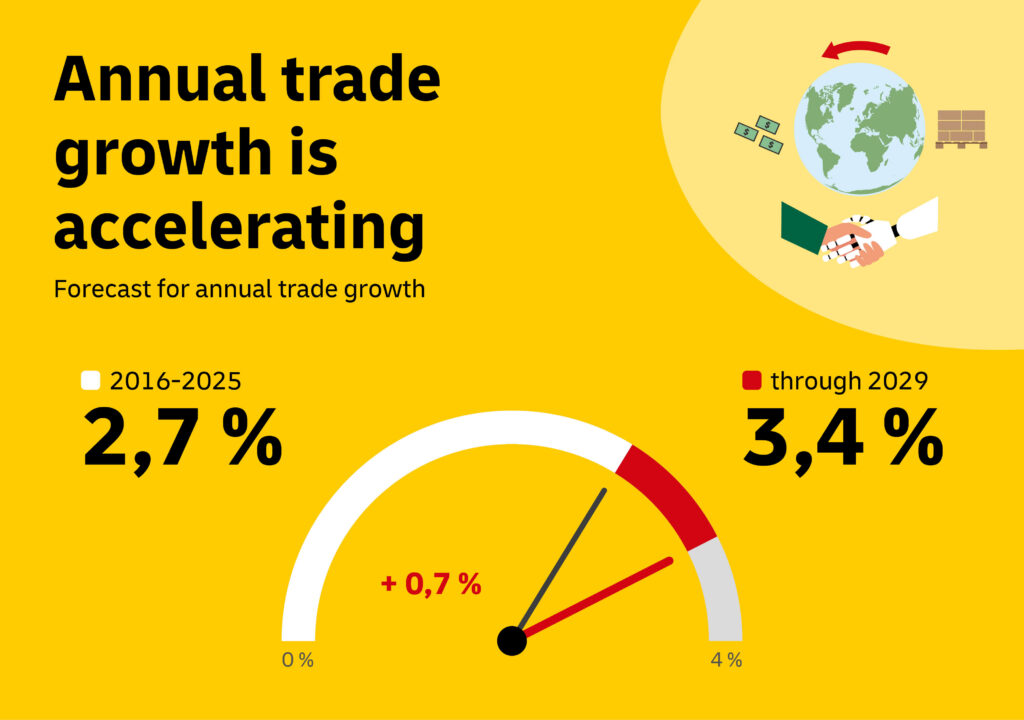
It is better than before the recent rounds of tariffs and the war with Iran. All four forecasting sources analyzed by the tracker now anticipate stronger trade growth than before these events occurred. From 2026 to 2029, the volume of goods traded is expected to grow by an average of 3.4% per year – up from 2.7% over the previous decade. However, after an exceptionally strong 2025 (+5.3%), the pace is expected to slow to 4.6% in 2026 and 3.6% in 2027.
Assuming a recovery once hostilities end – a scenario that remains uncertain –, trade is expected to grow fastest in the Middle East and North Africa. Next are South and Central Asia, followed by East Asia & the Pacific. In this forecast, Europe ranks last.
Nonetheless, the authors clearly identify risks:
- Dependence on the AI boom: because growth is heavily concentrated in goods related to AI, a slowdown in this sector would significantly impact global trade.
- Military escalation: further conflicts could impact major trade routes and/or trading nations.
- Volatile trade policy: new trade barriers are quite likely, for instance, in response to the increase in imports from China.
Download the DHL Globalization Tracker
All results from the DHL Globalization Tracker, including country profiles and interactive charts, can be found on the DHL website. There, you can filter and download data by country, region, and time period.
What do these results imply for companies in Europe?
The central message of the tracker is that international markets and supply chains remain significant in most industries. Companies that withdraw from international business while their competitors remain globally active will put themselves at a competitive disadvantage. For shippers, this presents several specific actions to take:
- Testing resilience byconducting targeted assessments of supply chains to determine how they respond to disruptions – without limiting access to foreign markets.
- Keeping an eye on concentration: Since 2022, trade in goods has become increasingly concentrated among a smaller number of partner countries, a trend that accelerated in early 2026. This increases the risk of one-sided dependencies.
- Detecting indirect dependencies: When switching suppliers, it is important to examine the origin of their intermediate products. Shifting to third countries does not automatically reduce risk.
- Using regional networks: Europe has a solid trade surplus. The continent’s efficient connections provide a foundation for adapting flexibly to shifts in demand and new supply chain models.
How does DHL Freight support companies operating in a dynamic trading environment?
At DHL Freight, we connect markets within European road freight – the very environment in which regional supply chains must stand the test. With Road Freight Standard, Road Freight Priority, and Road Freight Direct, we offer tiered solutions tailored to varying requirements for transit times and shipment volumes.
The myDHLFreight customer portal allows customers to digitally book and track their shipments. The Lead Time Calculator displays transit times for connections within the network. These tools allow for reliable transport planning, even during shifts in trade flows.
Globalization is being redefined, not reversed
Contrary to a widely held belief, the DHL Globalization Tracker shows no signs of globalization coming to an end. Global trade is growing strongly, and international activity is gaining ground relative to domestic activity. And, despite all the crises, the outlook has improved.
At the same time, patterns are changing. Trade flows between the U.S. and China are shifting significantly, regional trade is becoming more important in Asia, and the AI boom is generating substantial growth in just a few product categories. This means that companies must make their supply chains more resilient without sacrificing the benefits of international connectivity. Contact us if you’d like to align your European transportation operations with these trends.