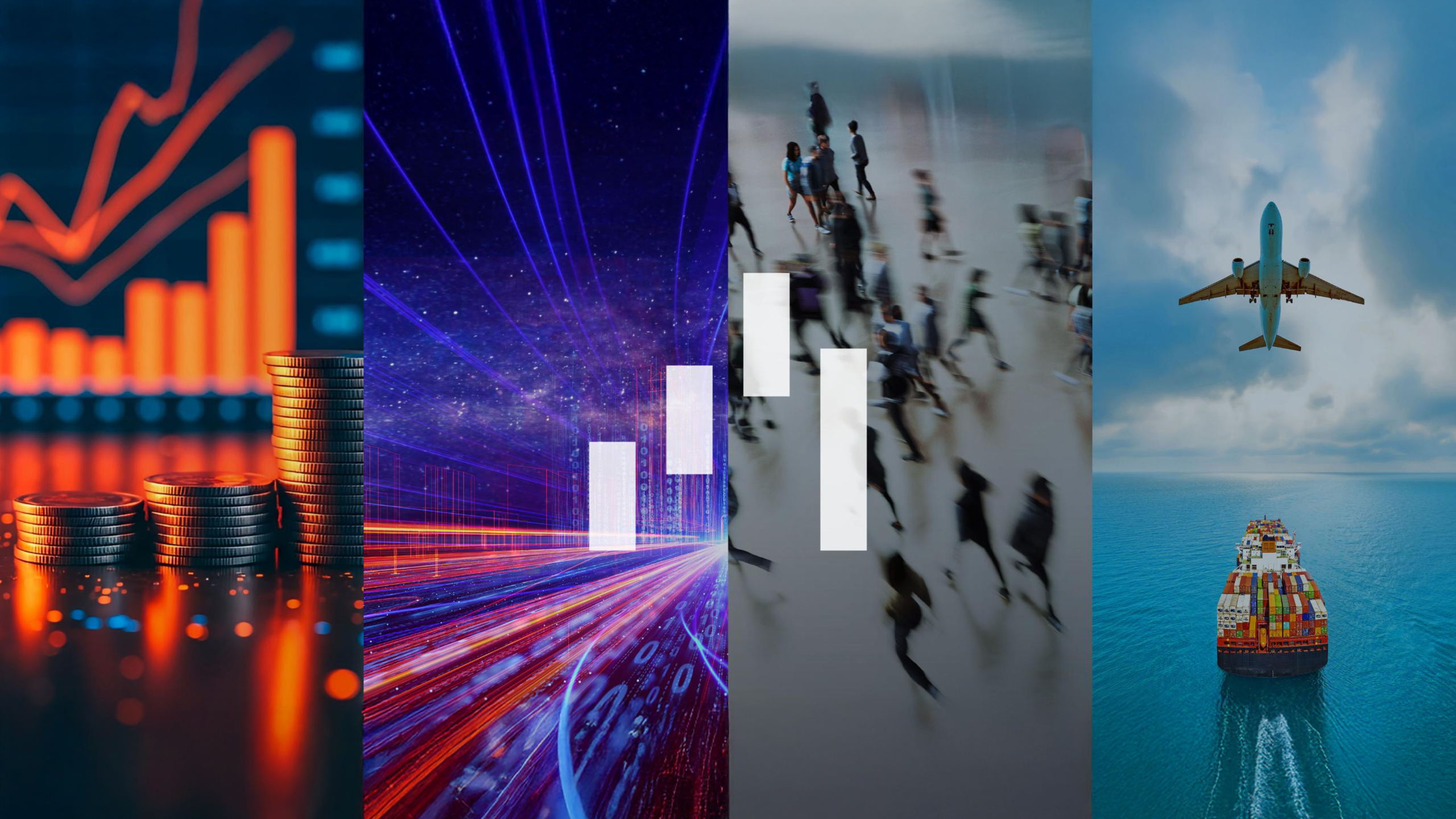
Since its first edition in 2011, the DHL Global Connectedness Report, published every two years, has evolved into the most comprehensive analysis of globalization. The 2026 edition draws on over nine million data points regarding trade, capital, information, and people flows in order to examine global trends and evaluate the level of connectivity of 180 countries.
What Does the DHL Global Connectedness Report Offer?
As the global market leader in logistics, DHL experiences changes in global trade flows firsthand. However, the flow of goods is only one aspect of globalization. Yet it is often equated with globalization in public debate. DHL takes a broader perspective on the issue. The DHL Global Connectedness Report 2026 tracks international trade flows, as well as global flows of capital, information, and people across 14 categories from 2001 to 2025.
Differentiated and Contextualized Analyses
The raw figures alone reveal little about the actual course of globalization. Specific questions on this topic can only be answered by placing these data in context and analyzing them in depth.
- Depth of international flows: To what extent are a country’s capital flows international rather than domestic?
- Breadth of international flows: To what extent are these flows spread out across the globe rather than concentrated at specific origins and destinations?
Operational Excellence and Research Excellence Contribute to the Report
The DHL Global Connectedness Report (formerly the DHL Global Connectedness Index) has been issued regularly since 2011. To create these reports, DHL combines its own insights with research from academic partners. As with previous editions, the 2026 Global Connectedness Report was developed in partnership with the Center for the Future of Management at New York University Stern School of Business.
At this leading center of excellence for data-driven globalization, DHL has launched an initiative. Its goal is to compile and maintain the most extensive academic database on the international flow of trade, capital, information, and people.
In a complex and rapidly changing world, timely data and analysis are essential. Amid dramatic swings in politics and public policy, the DHL Global Connectedness Report provides the most comprehensive available assessment of the actual flows of trade, capital, information, and people connecting countries around the world. This year’s findings strongly challenge the notion that the world has entered a period of deglobalization.
Steven Altman
Senior Research Scholar and Director of the DHL Initiative on Globalization at the Center for the Future of Management, NYU Stern
What Are the 10 Key Takeaways of the DHL Global Connectedness Report?
- Stable global connectedness: There is no shift from international to domestic activity across trade, capital, information, and people flows.
- Rapid growth in the trade of goods: Global trade grew faster in 2025 than in any year since 2017 (except for the COVID-19 pandemic).
- Continued growth in trade in the future: From 2026 to 2029, trade should grow at the same average pace as during the past decade.
- Further decline in ties between the US and China: Since 2016, the share of US trade, capital, information, and people flows with China has dropped 42%, while China’s share with the US is down 37%.
- Declining direct imports of goods from China to the US: From its peak of 22% in 2017, US imports from China fell to 13% in 2025, then plummeted further to 9% in the first three quarters of 2025.
- No split into disconnected geopolitical blocs: Only 4-6% of global goods trade, foreign direct investment, and cross-border mergers and acquisitions have shifted away from geopolitical rivals over the past decade.
- International business activities mostly between friendly countries: This limits the threat that de-risking strategies pose to globalization.
- Large average distances in trade and foreign direct investment: In 2025, both factors reached their highest average distances on record, while the share of these flows within key geographic regions fell to new lows.
- Singapore is the most globally connected country in the world. Singapore has the largest international flows relative to domestic activity, and the UK has the most global distribution of flows around the world.
- Misleading narratives about deglobalization: The world remains as interconnected as before. There have been no actual changes in cross-border flows. Headlines and public discourse are driven by political initiatives.
Despite Wars, Tariffs, Uncertainties: Will Global Economic Flows Continue to Grow?
The risks to globalization are real, as is the stability of international flows. In the face of dramatic geopolitical upheavals, two parallel trends have emerged:
- The future of globalization is being questioned more and more.
- Nonetheless, the international flows of trade, capital, information, and people remain stable.
Globalization reached a record high in 2022 and remained virtually unchanged through 2025. Despite the world becoming more complex and volatile, none of the four types of flows declined in 2024 or 2025. Information flows achieved the highest degree of globalization compared to the other three flows. Capital flows follow in second place, and then trade flows. People flows lag far behind, exhibiting a significantly lower degree of globalization.
Will Globalization Be Replaced by Regionalization?
Some experts have predicted a shift from globalization to regionalization due to concerns about the resilience of supply chains. However, these predictions are not reflected in global patterns of international activity. In fact, the latest data show that international flows have not become more regionalized in recent years. If anything, the opposite is true.
A key factor behind the increase in long-distance international flows is the growth of emerging economies. Consequently, opportunities for exchange between geographic regions have expanded.
Is Geopolitical Rivalry Splitting the Global Economy into Blocs?
Tensions and conflicts are fueling fears that the global economy could split into rival blocs, jeopardizing current economic relationships. The fact is: Relations between the US and China are deteriorating rapidly, and a deep divide exists between Russia and Western-oriented economies.
Other than that, global trade flows remain largely intact. Although there are signs that international trade and investment are aligning with geopolitical alliances, this fragmentation remains very limited. Most countries continue to maintain their traditional relationships, and a world divided along geopolitical lines is still far off.
Despite persistent pressures, the findings of this year’s DHL Global Connectedness Report offer reassurance: globalization is not reversing. It is reshaping and rebalancing, while remaining at a historically high level. Countries and companies continue to adapt with remarkable resilience.
Tobias Meyer
CEO DHL Group
Conclusion: Why Is Deglobalization Overrated?
By 2025, the world was more interconnected than ever before. This stands in stark contrast to the widespread view that globalization is in a state of upheaval, as evidenced by the stability of international trade flows.
This misconception likely results from an overemphasis on the largest economies or military superpowers. Because of their large domestic markets, these countries are less dependent on global trade. Consequently, their overall contribution to international trade is smaller than their share of global economic output suggests. In fact, the ten largest economies in the world generate two-thirds of global GDP, yet they account for less than half of total global trade.
Beyond the superpowers, an increasingly multipolar world is driving globalization. Also, the adaptability of companies and economies strengthens supply chains and globalization as a whole. “De-risking” is one of the buzzwords. However, de-risking strategies should not be equated with deglobalization or regionalization.
Overall, the DHL Global Connectedness Report 2026 does not depict an increasingly fragmented and regionalized world. Rather, it portrays a world in which connections are evolving.
You can download the full report and the key highlights brochure here.

FAQs on the DHL Global Connectedness Report 2026
1. What is the DHL Global Connectedness Report?
The DHL Global Connectedness Report is currently the most comprehensive analysis of globalization. It evaluates over nine million data points related to trade, capital, information, and people flows. The report assesses a total of 180 countries in terms of their level of interconnectedness.
2. Since when has the DHL Global Connectedness Report been issued?
The DHL Global Connectedness Report (formerly the DHL Global Connectedness Index) has been issued regularly since 2011. DHL collaborates with the Center for the Future of Management at the New York University Stern School of Business to create it. DHL launched an initiative at this center of excellence to compile the most comprehensive data set on globalization.
3. Is globalization declining?
Despite geopolitical crises and trade conflicts, the flows of international trade, capital, information, and people have remained stable. Globalization reached a record high in 2022 and remained virtually unchanged until 2025.
4. Is regionalization a lasting trend?
In recent years, the flows of international trade, capital, information, and people have not become more regionalized. Due to the growth of emerging economies, international flows over greater distances are even increasing.
5. Which is the most globalized country in the world?
Singapore has the strongest global connections of any country worldwide. In terms of its domestic business, the Southeast Asian city-state records the largest international capital flows. By contrast, Great Britain has the most widely distributed capital flows globally.