Without a doubt, the minimum requirement for high-quality delivery is to ensure the right goods arrive undamaged at the right place at the right time. However, quality and quality management in road freight entail much more. At Freight Connections, we discuss this important topic with two individuals who understand that quality is more than just a buzzword.
It’s More than Just On-Time Delivery – What Defines Quality in Road Freight?
Given the significance of quality in road freight, we arranged to talk to two experts for the Freight Connections blog.
As Chief Operating Officer, Christian Griesshaber oversees the operations of all DHL Freight products, significantly influencing their quality. Monika Harth heads global quality management at DHL Freight. They both know what matters when it comes to quality in road freight.

What Constitutes Quality for DHL Freight?
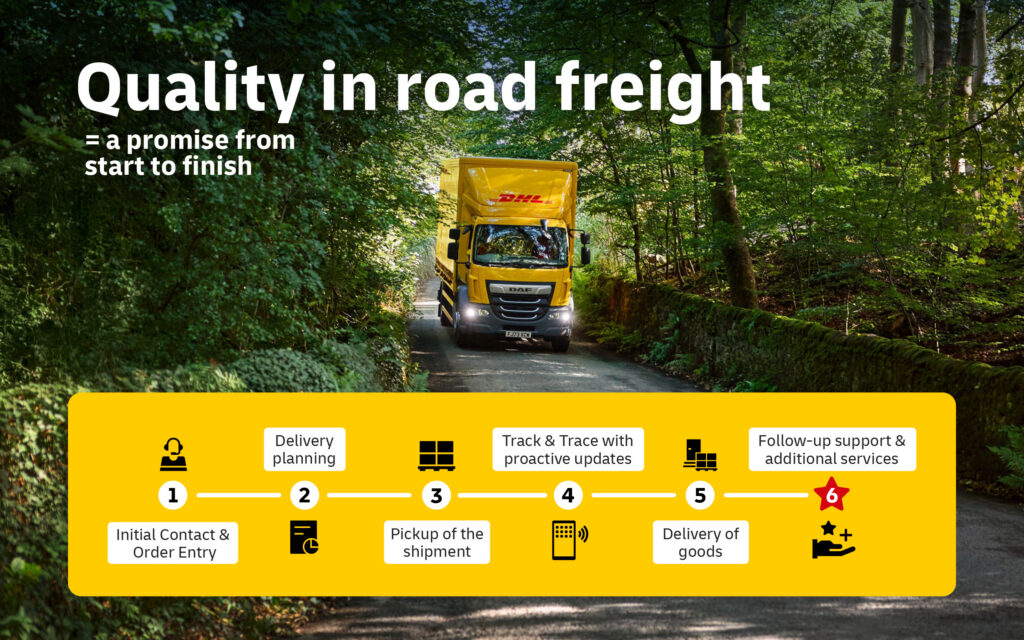
Obviously, punctuality is important when it comes to deliveries, but it’s not the only thing that matters. “Quality isn’t just about on-time delivery; it’s about the overall promise we make to our customers throughout the entire process, from start to finish,” Christian Griesshaber says.
At DHL Freight, quality begins with a professional initial contact, during which the shipment is discussed in detail. Then, transparent tracking and tracing is provided throughout the entire delivery process, from pickup to delivery. “If something doesn’t follow the plan – for instance, due to weather or traffic conditions – we proactively inform customers why their delivery hasn’t arrived yet and when it will arrive.”
At DHL Freight, quality extends beyond delivery. There are open channels for clarifying details and arranging additional value-added services.
Quality isn’t just about on-time delivery; it’s about the overall promise we make to our customers throughout the entire process, from start to finish.
Christian Griesshaber, COO DHL Freight
How Does DHL Freight Measure Quality?
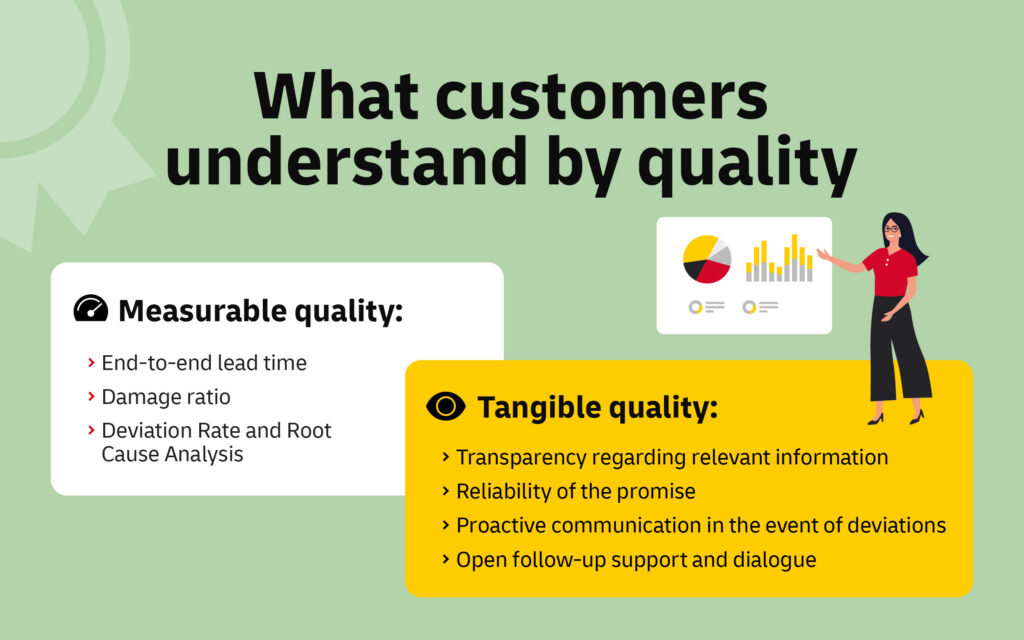
First, objective key performance indicators (KPIs) play an important role in the quality of road freight. As Christian Griesshaber explains, classic KPIs are related to either the end-to-end lead time or the damage ratio.
There are also KPIs for the entire delivery process that indicate the quality of performance at pickup, between terminals, during transshipment, and at delivery. “We use reporting and analysis tools to track the various types of KPIs so that we can identify potential shortcomings and make improvements,” notes Griesshaber. “Regular performance dialogues with our employees and review meetings with customers are also helpful. What went well? What could be improved?”
How Does DHL Freight Ensure Quality?
Customers are distinct individuals with specific requirements. This is why DHL Freight does not offer a one-size-fits-all standard delivery service. We take individual customer requirements into account. For example, some customers prioritize speed, while others prioritize precise scheduling, even if it extends the delivery time. The result is a wide range of services with a high, universally applicable quality standard that we continuously work to improve.
Therefore, Monika Harth emphasizes that quality is multifaceted. The crucial question is: “What does this customer value, and how can we ensure everything works well from start to finish?”
Continuous Training and Feedback Loops
According to Christian Griesshaber, all employees receive continuous training to keep them up to date on day-to-day business. This allows them to competently use shipment tools and proactively inform customers about their deliveries.
If something does not go perfectly, the reasons are clarified afterwards and ways to improve next time are considered – preferably together with customers. This can involve various aspects, such as the flow of information or the type of packaging. Ultimately, the goal is to deliver even higher quality next time.
Quality Teams at All Levels, from Global to Local
At the organizational level, there are dedicated teams that focus on quality. This begins with Monika Harth’s team at the global level and continues with each cluster, country, and terminal. Additionally, KPI managers are involved in operational processes. They monitor KPIs and develop improvement measures to continuously increase quality.
Terminal Classification at DHL Freight
“At DHL Freight, quality culture is not something just done on the side. It is upheld throughout the entire year. We aspire to be the quality leader, which is why we embody, assess, and continuously improve quality,” says Christian Griesshaber.
Terminal classification is a particularly critical tool for DHL Freight. Christian Griesshaber clarifies: “This is where our standards are validated across all terminals and process steps. Once a year, we conduct a comprehensive review to assess and refine our quality standards and verify that they can be implemented everywhere. This ensures that quality remains at the desired level throughout Europe.”
At DHL Freight, quality culture is not something just done on the side. It is upheld throughout the entire year. We aspire to be the quality leader, which is why we embody, assess, and continuously improve quality.
Christian Griesshaber, COO DHL Freight
What Is the Role of Standardized Processes and Technology in Ensuring Consistent Quality?
“Uniform process standards are a key element in ensuring quality, especially in a network,” Monika Harth points out. “Standards are essential to ensure that processes run smoothly, responsibilities are clear, and the whole picture is captured in an integrated way. Then, everyone knows what to do and how their individual contribution creates a positive customer experience.”
Nevertheless, challenges and incidents are part of day-to-day logistics business. “We address these issues with system support and, most importantly, informational support,” explains Harth. “Proactive and open communication with customers is another key element in ensuring a high-quality customer experience.”
At DHL Freight, process standardization is ensured through terminal classification and evaluation of individual process steps, from local to global, to drive continuous improvement of all elements.
Uniform process standards are a key element in ensuring quality, especially in a network.
Monika Harth, Head of Operations Strategy & Global Quality DHL Freight
How Important Are Technological Advancements and Digitization for Standardization and Quality?
“Technology and digitization allow for transparency regarding shipment flow, as well as the success of and compliance with transit times and process standards,” comments Monika Harth. “It also supports processes, for example, through active monitoring.” A scanner can not only identify damage but also document it with pictures. This permits faster action. All of this naturally improves process quality.”
Christian Griesshaber adds: “DHL Freight is the only land freight provider with an integrated transport management system for its entire Europe-wide network. This means we can offer uniform standards and unique transparency because there are no interface problems between the various subsystems of a transport management system.”
The transport management system enables collaborative work on processes with the same information. It provides a comprehensive overview of all process steps, involving proper quality control and understanding of customer promises among our employees. “This is how we want to work with customers. It’s an important process that we introduced a few years ago and hold in very high regard.”
Furthermore, the myDHLFreight customer portal has led to greater standardization and harmonization of data, as well as improved data quality. Consequently, customers have experienced higher service quality.
What Is the Role of AI in Quality Assurance?
“From the customer’s point of view, the Viva chatbot is, of course, the outstanding tool because it supports customer service and can be experienced directly. For instance, customers can get answers to questions about shipments, the current status, or the next expected delivery,” explains Christian Griesshaber. “Of course, there are also internal applications on the operational side where AI helps us work more efficiently.”
How Crucial Is Transparency for Perceived Quality from the Customer’s Perspective?
“Transparency is very, very important to us at DHL in order to meet customer requirements,” Christian Griesshaber emphasizes. That said, transparency does not mean informing customers about every internal step.
Rather, it is crucial to proactively provide customers with information that is relevant to them, such as pickup times and delivery status.
Where Is Human Involvement Essential for Quality?
In a volume business like road freight, technological solutions are essential for efficiency and future viability. However, this does not make the human factor obsolete.
Christian Griesshaber notes: “Aligning customer expectations with DHL Freight’s promises works best when people communicate with each other – not just once when a shipment is received, but throughout the entire process, and optionally in joint reviews at the end.”
Monika Harth highlights the human factor’s importance in the concept of quality. “A culture of quality depends on the commitment of every employee. It depends on each person taking responsibility for their step in the process, actively shaping it, and contributing to the overall quality of the process.”
Aligning customer expectations with DHL Freight’s promises works best when people communicate with each other.
Christian Griesshaber, COO DHL Freight
How Does DHL Freight Manage Deviations?
“If an operational problem arises, it is recorded in the system and communicated via a status update. If necessary, customer service will handle it directly with the customer. Customers are informed about how the situation is being addressed and what will happen next,” Monika Harth explains.
In addition, DHL Freight has established systems for quality monitoring and performance management. Cause analyses identify potential structural problems or recurring issues. Then, improvement measures and optimizations are implemented accordingly.
Monika Harth provides another example: “In terms of first choice, we at DHL Freight use continuous improvement process (CIP) concepts such as ‘See it, sort it, fix it.’ This clearly illustrates how we address deviations.”
In terms of first choice, we at DHL Freight use CIP concepts such as ‘See it, sort it, fix it.’ This clearly illustrates how we address deviations.
Monika Harth, Head of Operations Strategy & Global Quality DHL Freight
Which Quality Requirements Will Become More Important in the Coming Years?
Christian Griesshaber is convinced: “Demand for transparency will certainly increase to ensure that promises and actual conditions always align. Our challenge is to manage this so well that, ultimately, the product meets customer expectations.”
Moreover, expectations concerning delivery speed are rising, and the future will be even more digital. “Self-service tools like myDHLFreight are one example of this. With these tools, we must provide information both reactively and proactively.”
How Do Sustainability and Quality Relate to Each Other?
“When we try to optimize our productivity, it always has something to do with sustainability," affirms Christian Griesshaber. Efficient shipments that require as few trucks as possible contribute to sustainability.”
Of course, alternative drive systems such as e-mobility also play a role at DHL. But efficiency through quality is no less important. It prevents extra trips, empty runs, ad hoc pickups, and additional planning – and thus promotes sustainability.
What Are the Quality Features Distinctive to DHL Freight?
“We have the densest network, with a huge number of terminals and corresponding connections,” Christian Griesshaber states confidently. This is an objective quality feature. “Quality and customer promises mean a lot to us. We want to do things differently and, as the ‘yellow family’, always keep our customers in mind.”
After all, everyone at DHL Freight is committed to high-quality service and to meeting high customer expectations. “These efforts create satisfied customers who remain loyal to us in the long term and with whom we wish to further develop our business relationships.”
To fulfill our customer promise and deliver a positive customer experience, it is crucial that we all contribute to quality.
Monika Harth, Head of Operations Strategy & Global Quality DHL Freight
Quality as the Goal and Driver of Innovation
Throughout the conversation, it becomes clear that both Monika Harth and Christian Griesshaber are deeply committed to the pursuit of quality. They both demonstrate a personal passion for the topic. Harth considers quality a fundamental component of daily work. “Whether in the office, in the warehouse, or in the driver’s cab: To fulfill our customer promise and deliver a positive customer experience, it is crucial that we all contribute to quality.“
For Monika Harth, quality is an overarching goal that allows DHL Freight’s products and services to be successfully implemented on the market. Christian Griesshaber agrees. He adds: „Quality is a hallmark of how we work together, how we treat each other with respect, and how we serve our customers with respect. By doing this, we put our customers at the center of our attention. Our goal is to make sure they receive what they were promised.“
Quality is a hallmark of how we work together, how we treat each other with respect, and how we serve our customers with respect.
Christian Griesshaber, COO DHL Freight