Stefan Heilmann, Managing Director and Head of IEG Internet Desk, IEG [Photo: Heilmann]
The fourth industrial revolution is characterized by the rise of the internet and the explosive growth of mobile devices. Both have impacted our everyday life and consequently the customer behavior massively which led to the digitalization of all industries. Stefan Heilmann, Managing Director at IEG – Investment Banking Group shows eight trends, that will push the digitalization the most.
1. Triple Play
Triple Play entails the interplay of software, hardware and services. Achieving the perfect combination creates an ecosystem that benefits customers and company. CLAAS for example has created a bi-directional path to their customers and services. 40 years ago, CLAAS offered exclusively agricultural machinery with an after-sale service. These days, CLAAS is a pioneer for digitization in its own industry by becoming a software, satellite and telemetric business.
2. Mobile Only
Mobile is the predominant medium for people to handle their personal as well as their professional life. Thinking “online first, mobile second” is outdated and will not be accepted by users. An evaluation of all available DHL apps shows, that there are approx. 19 apps, of which 1/3 are purely used for marketing reasons (i.e. sponsorships). The other 2/3 are covering various aspects of the DHL service. The smart way to do it is to create one application that covers all services.
3. New Ownership
The concept of ownership has been revolutionized. Sharing instead of owning: cars (BlaBla Car), music (Spotify, SoundCloud, Deezer), clothes (DressCode), real estate (AirBNB) or data (Dropbox, Box). One prominent example is wework, a company that offers co-working space. A business model that is not new but by creating a community due to a high quality of tenants who interact with each other, wework is ahead of its competition. A success story that is proven by its valuation increase from USD 5 billion in December 2014 to USD 16 billion in March 2016.
Stefan Heilmann Managing Director and Head of IEG Internet Desk, IEG – Investment Banking Group. IEG – Investment Banking Group is one of the leading, global independent investment banking boutiques focused on Mergers & Acquisitions, Financing & Corporate Advisory for Internet, Technology & Services.
4. User Interface (UI) is Emporer
The digital natives set the standards for the design of user interfaces and user experience. Any product that needs to be explained by a user manual or is not user intuitive will not stay competitive, proven by the automobile industry. The trend moves toward a dashboard that reminds customers of their smart phone – screens instead of buttons and levelers. Expectations that most big players such as Mercedes, Audi and Nissan can meet 2020 earliest. Unlike the Chinese company Geely whose design of the Volvo XC90 - dashboard focuses on these trends exactly.
5. Content is King
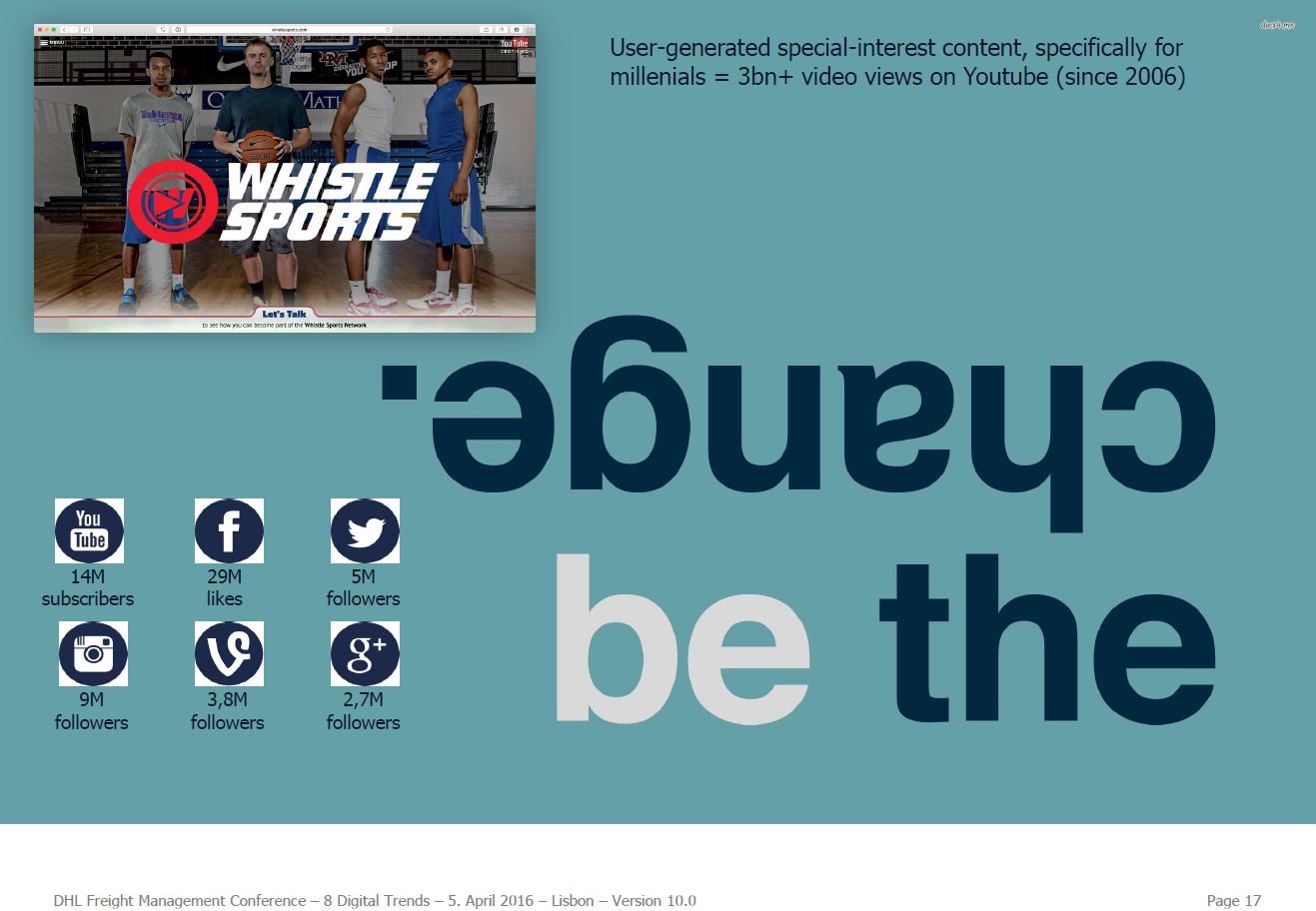
Google is changing algorithms so drastically, that even a powerful company like DHL will not be able to buy all necessary Google Adwords to stay ahead of their competition in the search rankings. Key is to focus on new, self-designed and written content instead. Rich content will engage users and user engagement is the most important KPI for Google to rank websites. Buzzfeed is a great example in order to grab the dimension of the importance of having a great content marketing strategy. Buzzfeed became the largest broadcaster for the Millennials (18-34 yrs old) in the US, leaving CBS, NBC and CNN behind.
6. Actionabla Data
Data is a major buzz word. Truth is though, 97% of data gets wasted. For corporations it will therefore become essential to achieve real progress in how to use data efficiently. API infrastructures need to be created so that different sets of data are accessible all the time. A perfect example is Dataminr. A company that access the whole data base of twitter and offering their results to companies or organization – such as the Boston Police Department. By analyzing all relevant twitter data streams, Dataminr is able to detect anomalies and reports these to the BPD. They can reach crime scenes faster, can solve crime more efficiently and can drop the crime rate in general.
7. Digital Health
More than ever people care about their looks, body and health. Consumers want to live a better, healthier and more active lifestyle. This new lifestyle has increased the popularity of wearables and very sophisticated mobile diagnostics. Consumers are able to measure their food, its ingredients and nutrition as well as their daily work-out constantly. Also, a massive raise on the e-commerce side is noticeable in regard of functional food. People purchase food based on which function (weight loss, muscle build etc.) it should serve. And it will not end here – the next trend will most likely be artificial food.
8. Infrastructure Free-Ride
This trend is very tricky. Digital business models are often created within infrastructure-expensive environments. They help themselves by using already existing environments and putting their own KPI on top of it – for free or at least partially for free. One example is Skype, which used the infrastructure of the Deutsche Telekom for their services. Another very prominent and hotly debated example is Uber. Uber uses the infrastructure of existing cars of private people by letting these people get registered with their cars at Uber and become a driver for the company.
This article is based on the keynote by Stefan Heilmann, Managing Director at IEG – Investment Banking Group, held during the DHL Freight Management Conference on April 5th 2016 in Lisbon.
Shall we explore this topic in more depth?
Curious? Our authors will be happy to help you. Just send us a short message—and we'll dive deeper together.
[The 21st of March 2016 was an important date for the future of the German logistics sector. It was on that day that Federal Minister of Transport Alexander Dobrindt introduced the draft bill for the Federal Transport Infrastructure Plan 2030. Thus, the infrastructure planning policy for the next 14 years is now on the table. But how do Germany's logistics experts evaluate the decisions, and what expectations do they have of the current discussion phase? Freight Connections spoke with Matthias Krage, President of the German Freight Forwarding and Logistics Association (DSLV – Deutscher Speditions- und Logistikverband).
[The United States are going under in traffic jams, as roads and bridges are increasingly falling into disrepair. But that should now change thanks to the FAST Act.


![Stefan Heilmann, Managing Director and Head of IEG Internet Desk, IEG [Photo: Heilmann]](http://dhl-freight-connections.com/wp-content/uploads/2016/06/SO_Heilmann_Content-200x200.jpg)
![Stefan Heilmann, Managing Director and Head of IEG Internet Desk, IEG [Photo: Heilmann]](http://dhl-freight-connections.com/wp-content/uploads/2016/06/SO_Heilmann_Content.jpg)