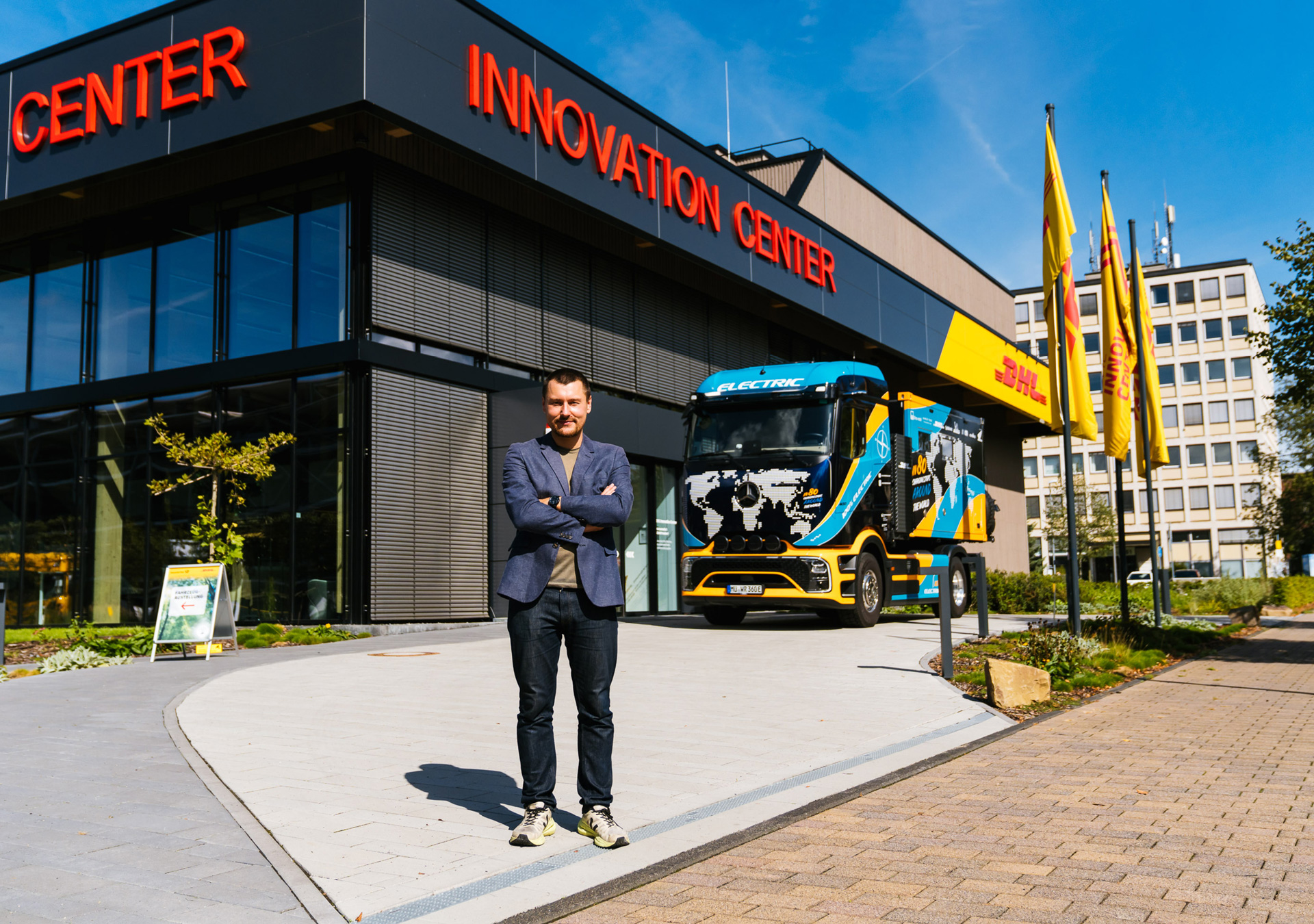
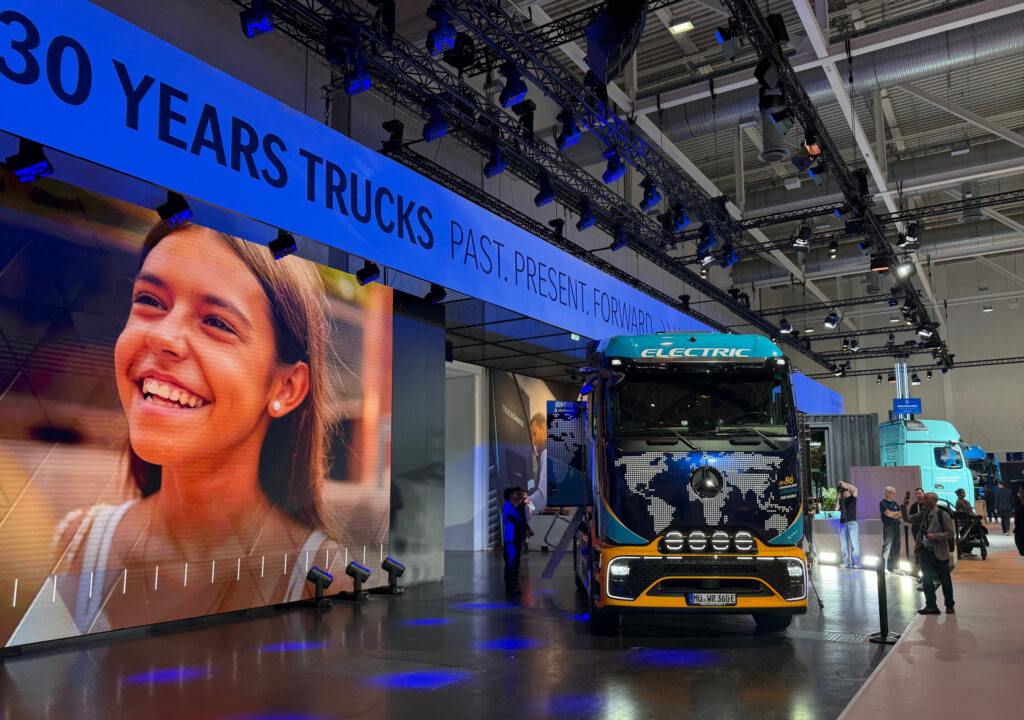
Some questions are never asked because the answer seems to have already been decided upon. “Can a battery-electric truck drive around the world?” is one such question. However, Tobias Wagner – known in the industry as “Elektrotrucker” – has asked it anyway and will answer it in the only way that matters: simply by hitting the road at IAA Transportation 2026.
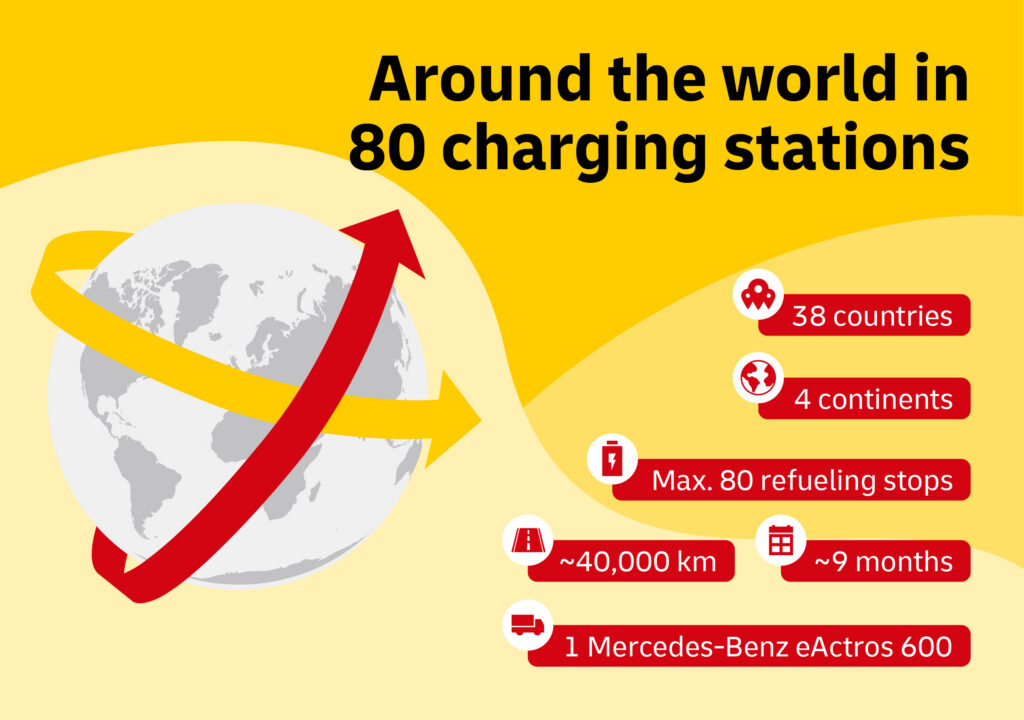
A trip around the world: about 40,000 kilometers, 38 countries, and four continents in a Mercedes-Benz eActros 600 with a sleeper cab. And all this with a maximum of 80 charging stops. We are supporting this endeavor as a partner, and here we reveal all about this man and his journey, which is much more than just an adventure.
Who is the man to travel round the globe in an electric truck?
“My name is Tobias Wagner. I’m 33 years old and a long-haul truck driver,” he says of himself. “But not with regular diesel trucks you’re familiar with – only battery-electric ones.”
For two years, this is what he has been doing. He has driven over 200,000 kilometers entirely on electric power through more than 24 countries – from the Bosporus to Lisbon and all the way up to Lapland, where the temperature was minus 34 degrees. He did it in a long-haul semi-trailer truck with a gross vehicle weight of 42 tons.
“I made it everywhere and broke down nowhere,” he sums up that period. The experiment turned into a role. Today, Wagner is one of the most visible advocates for electrification in road freight, boasting over 145,000 followers on YouTube, Instagram, and LinkedIn.
I made it everywhere and broke down nowhere.
Tobias Wagner
Elektrotrucker
How does an entrepreneur become a truck driver?
This transition had initially more to do with electricity than with trucks. After studying modern mobility management and working at companies including The Mobility House and Tesla, Wagner spent seven years building his own company focused on charging infrastructure for automobiles, including hardware, software, etc.
Everything changed one weekend when he drove a borrowed Tesla Model S P90D. “That’s when I was hooked. That’s when I knew this was the future, and I wanted to be a part of it somehow.”
After ten years in the electric passenger car sector, however, the appeal had worn off. Batteries were getting bigger, charging capacities were increasing, and you could drive anywhere. It was essentially the same old story repeating itself.
At the same time, though, a childhood dream had never quite faded – driving trucks. “It was always kind of a backup plan: if everything goes wrong in my life, I’ll just drive trucks.”
When the first battery-electric long-distance trucks hit the market, things came together. Wagner quit his job at his own company, hired a successor, paid for his commercial driver’s license out of his own pocket – and hit a wall. No trucking company would hire an electric trucker. “Two years ago, everyone said: ‘Impossible, it can’t be done – there’s no charging infrastructure anywhere.’”
One company said yes – the Nanno Janssen forwarding company from the northern German region of East Frisia, which is systematically electrifying its fleet. “I was the guinea pig who got to try it out,” says Wagner of his early days there. “The last two years have really been great.”
How did the idea to travel around the world come about?
After visiting 24 countries and every corner of Europe, a new question arose: Is there anywhere I cannot go?
After doing some research, Wagner discovered that no one had ever driven a battery-electric truck around the world. His conclusion was pragmatic as well as uncompromising: “If we’re going to do it, it has to be now. In five years, no one will care anymore. And five years ago, no one would have cared either.”
At the beginning of the year, he started reaching out to potential partners. By his own account, he was relatively naïve, yet the result was surprising: many said yes. Among them were companies that he had approached two years earlier when he was trying to break into electric long-haul trucking. They had turned him down at the time. “Now, two years later, the world has completely changed. It’s amazing how open-minded people are now.”
The result was a consortium consisting of Daimler Truck, DHL, Bliss Mobil, Michelin, and Alpitronic. In just a few months, they transformed a serial vehicle into an expedition truck – within a timeframe that many considered impossible.
Many people said it was impossible. Yet here it stands, and here I am, sitting inside it.
Tobias Wagner
Elektrotrucker
What makes this eActros 600 an expedition vehicle?
Surprisingly, very little – and this is exactly the point. The powertrain, batteries, and electric axle are all standard. „We didn‘t tinker with it much,“ reveals Wagner.
Essentially, the modifications were all about preparing the truck for rough terrain, including single tires on the rear axle, off-road or construction tires, a tire pressure control system, and a flip-up impact protection. Add to that the 13-foot Bliss Mobil sleeper cabin mounted on a short-wheelbase chassis with a long frame overhang – a configuration that practically no one orders.
One detail reveals just how new this venture is. Unlike electric passenger cars, modern electric trucks cannot be charged with alternating current. They are designed exclusively for direct-current fast charging. Thus, Wagner has his own Alpitronic charging unit on board that he can pull out from the side.
According to Wagner, the vehicle is registered as the heaviest electric RV in Germany. “The registration office was a bit overwhelmed by all the details.”
What about the looks? There is no camouflage-style expedition look. “It’s meant to send a message to the world that electric mobility is here to stay. Above all, it’s a European project because all the companies contributed.”
Where does the route lead?
A true circumnavigation follows certain rules. It must cross all lines of longitude and pass over the equator. The route is designed with this in mind.
Starting in Germany, the journey goes through the Balkans to Turkey, then continues overland toward Central Asia – a corridor with little room for maneuver between troubled regions. “It’s theoretically possible,” states Wagner. “But I won’t believe it until I’m there.”
Then comes China, which he considers the most exciting part of the entire trip. From there, he will travel through Laos, Thailand, and Malaysia to Singapore. Next, he will take a ship to Australia and travel along the south coast. After that, Wagner will continue to Seattle and then down the Pan-American Highway to South America. From Uruguay, he’ll head back to Europe.
Africa is being left out on purpose. “For one thing, the trip is ambitious enough as it is. Plus, you’ve got to leave some room for the next project.”
The future has long since been invented. It’s just not distributed evenly. And right now, a little more is happening in China than here.
Tobias Wagner
Elektrotrucker
When does it get really difficult?
“It’s not the vehicle,” says Wagner. The truck already has about 10,000 kilometers on the odometer. “The distance it’s covering on this round-the-world trip is what it normally covers in 23 months. If there were a problem, it would have happened by now.”
The real unknown is the charging infrastructure, and one section stands out: Central Asia in winter. Kyrgyzstan, mountain passes, and the cold. Wagner is torn between two scenarios: either there is not a single charge point in sight, or there are perfectly normal charging stations because electric cars have been driving there for a long time.
What is striking, there are no signs of fear. “There will be a solution for everything.” As a content creator, his perspective on risk is different anyway. If everything goes smoothly, it’s the best proof of the technology’s viability. If something goes wrong, it’s a story you won't tell a second time.
If you look at things that way – and that’s how you should generally look at life – then you can look forward to the future.
Tobias Wagner
Elektrotrucker
One companion will be missing, though. Krümelix, his dog and co-pilot for the past few years, will likely stay at home with Wagner’s parents due to entry and quarantine requirements. “It’s a bit of a bummer, but it makes the trip easier to plan.”
The rest of the luggage is manageable: cameras, an electric motorcycle as a support vehicle, recovery gear, and two spare tires. “It’s 2026. There’s nothing in the world I couldn’t buy along the way.”
We’ll take you along on his journey
From Germany to Central Asia to South America: on our project page, you can follow his trip around the world, stage by stage. A map shows the most important stops along the route, each accompanied by photos, videos, and impressions from the journey. You won’t miss a single milestone of this trip!
What has actually changed in the past two years?
For all logistics professionals responsible for a vehicle fleet, this is the most interesting part of the conversation. Wagner observes the rollout not from the conference room, but from the driver’s cab.
- Diversity of models: “It’s really impressive that every manufacturer now offers an electric truck suitable for long-haul transport.” What were once niche products have become standard models.
- Charging infrastructure: At first, he was struggling to make ends meet, often unhitching the trailer and using loading spaces intended for passenger cars. Today, there are more charging solutions for semi-trailer trucks to pass through.
- Economic efficiency of charging stations: Operators have realized that a single truck accounts for as much energy as about 20 passenger cars – while providing better utilization.
- Framework: „It’s fair to say that policymakers have certainly delivered“ – through support programs and the extended toll exemption.
Here is Wagner’s conclusion for forwarders who are still holding back: the conditions are currently favorable. Those who do not take advantage of the toll exemption for the first few years are missing out on part of the benefit.
Why do forwarders hesitate?
At this point, the conversation becomes uncomfortable – for those presenting the counterarguments. Wagner considers the usual objections to be mere pretexts.
“They all have the range. You can’t even drain the eActros’s battery in four and a half hours.” After speaking with hundreds of drivers and business owners, he identified two very different factors.
First, the succession plan. “If you don't know what will happen to your trucking company in five to ten years, then you’re not going to invest millions.” Once the succession is settled, investments are made – this is a business-related decision, not a technical one.
Second, the question of who owns the truck. “Everyone complains about electric vehicles as long as it’s not their own truck. But once they’re assigned an electric truck, it’s suddenly the best truck in the world.”
What is the difference in everyday life? Wagner, who went straight to electric and has only occasionally driven a diesel vehicle as a temporary solution, points out one specific thing: rest periods and charging times must be planned together. “That’s the only thing you have to adjust to.” He checks the app instead of following the next parking sign to do this. When considering switching back to diesel, he says: “There’s a tremendous amount of background noise, and it can’t get going because it feels like it has to shift gears 20 times.”
What is DHL’s role in this journey?
The collaboration began during the planning phase, stemming from a specific question: What does this project really need? Two answers quickly became clear: intercontinental shipping and supplying spare parts en route.
“I believe DHL is the world’s largest logistics provider. If anyone can do it, it’s DHL,” asserts Wagner. The decision to collaborate was made quickly.
The result is more than just the organization of transport. It is pioneering work on a question that will soon be on many people’s minds: How do you ship a used electric truck across oceans? What safety regulations apply to batteries of this size on board?"
Without DHL, a project like this wouldn’t be possible. This is truly pioneering work.
Tobias Wagner
Elektrotrucker
Wagner is convinced that this will become a blueprint. In the overlanding community, electric trucks are increasingly being converted into vehicles for traveling the world. “I think that helps everyone.”
While on the road, he plans to visit locations along the route and document how things are done elsewhere. “What’s working well for us? What might not be working so well? Everyone should take these kinds of exploratory trips regularly.“
Why we are supporting this mission
Because it provides the exact answers to the questions we face daily in the trucking industry.
The future of road freight won’t be determined by declarations of intent, but rather by what happens on the road itself: at charging stations, mountain passes, border crossings, and in route planning. DHL Freight is working on this transformation with customers, subcontractors, and partners who want to know what is possible today – and what is not.
Wagner’s journey provides answers that no study can deliver. It demonstrates where battery-electric long-distance transport is reliable, where problems arise, and what is required to address them. Every kilometer is covered under real-world conditions and publicly documented – unfiltered, even when something does not work.
Additionally, there’s something that’s harder to measure. Wagner sums it up himself: “Projects like this motivate people – drivers, dispatchers, carriers, and partner companies – everyone who wants to be part of the change rather than just manage it. You’re part of a bigger message. It’s a once-in-a-lifetime thing that you can’t repeat."
That is why his goals are our goals, too.
One truck, 38 countries, and one question nobody will ever ask again
In a few days’ time, an eActros 600 will set off from the IAA Transportation trade show bound for the Balkans. One driver, one sleeper cab, and an electric motorcycle in support. Nine months during which quite a lot can go wrong.
Wagner deliberately avoids turning this into a heroic epic himself. He plans three to four weeks in advance and figures out the rest as he goes along. “I don't make it bigger than it needs to be.” Perhaps the most impressive thing about this project is that the man doing something no one has ever done before believes it’s feasible.
When he gets back in just over nine months, the question of whether a battery-electric truck can drive around the world will finally be answered. Not through theory. But through 40,000 kilometers.
We wish Tobias Wagner a safe journey and look forward to sharing every kilometer with him.