
Even though demand for transportation is growing only slowly, prices in the European road freight sector have risen significantly in 2026. This is primarily due to the increased costs of diesel, tolls, CO₂ pricing, and labor. There is no relief in sight for any of these factors in 2027. This guide explains which cost drivers influence transport costs and how shippers can address them.
How did road freight costs develop in 2026?
The European Road Freight Rate Benchmark report, published by the International Road Transport Union (IRU), Upply, and Transport Intelligence (Ti), tracks quarterly trends in freight rates on major international routes in Europe. In the first half of 2026, both contract and spot rates increased considerably. Spot rates increased particularly sharply in the second quarter.
| Figure | Q1 2026 | Q2 2026 |
| Contract rates (index, January 2017 = 100) | 140,1 | 148,0 |
| Spot rates (index, January 2017 = 100) | 132,3 | 146,8 |
| Trade volume by road comp. to the previous year | –8% | –1,6% |
The figures show that demand remains weak, yet prices are rising. The IRU expects a 0.6% increase in transport volume in 2026. Therefore, rates are primarily driven by costs. According to the French CNR Index – the key benchmark for costs and prices in road freight transport – operating costs for long-haul transport were almost 10% higher in the second quarter of 2026 than in the previous year.
Which cost drivers prevail in 2026/2027, and how can they be reduced?
The cost of road transport is currently determined by five factors. While some of these factors are beyond the control of shippers, others offer more potential for them to take action. The following sections categorize each cost driver and identify which levers companies can control.
What impact do diesel prices have on transport costs?
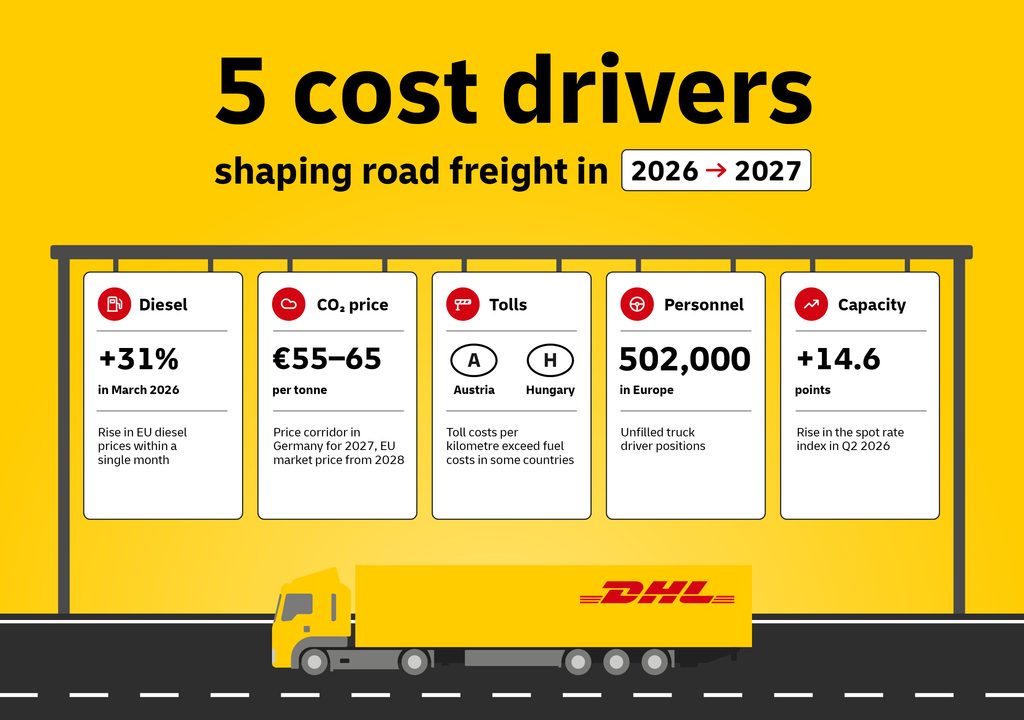
Fuel is the largest variable cost in long-haul trucking. According to the IRU, the average price of diesel in the EU increased by 31% in March 2026 alone. During the second quarter, the average price was €1.94 per liter.
Transport companies cannot absorb price spikes of this magnitude. They pass these increases on to their customers via a fuel surcharge, also known as diesel floater, which is linked to changes in diesel prices. The price of diesel in 2027 will depend heavily on the geopolitical situation. In the short term, analysts at Transporeon expect diesel to remain the key cost driver in European road freight transport.
- Increasing capacity utilization: the fuller the truck, the lower the fuel consumption per pallet. You can reduce the number of trips by consolidating shipments and scheduling pickups.
- Understanding how surcharges are calculated: a fuel surcharge linked to a public price index provides transparency regarding cost changes. Ask about the base value, the index, and how often adjustments are made.
- Avoiding empty runs: fixed time slots for loading and unloading allow service providers to plan their routes and backhauls more efficiently.
What will CO₂ pricing mean for shippers until 2028?
In the EU, individual member states have national emissions trading systems. Alongside the EU Emissions Trading System (ETS) for buildings and transportation, they drive up the cost of fossil fuels. They were originally set to be replaced in 2027 by the revised ETS (ETS2) which will also be binding for countries without their own CO2 pricing system. However, the EU has officially postponed the launch of ETS2 to 2028.
For example, a price range of 55 to 65 euros per metric ton of CO₂ is expected to remain in effect in Germany in 2027. This equates to a CO₂ share of approximately 17 to 20 cents per liter of diesel, including the value-added tax. Starting in 2028, the price will be determined by the market across the EU, and forecasts vary widely. Diesel will thus become more expensive in countries without their own CO₂ price due to emissions trading.
- Plan for scenarios: rather than extending the current price range, include the CO₂ price that will take effect in 2028 as a variable in budgets and tenders.
- Checking intermodal transport options: for long routes, shifting the main leg of the journey to rail can reduce diesel consumption per shipment.
- Integrating alternative drive systems: electric trucks and renewable fuels, such as HVO, can reduce the proportion of fossil diesel on which the CO₂ price is levied.
Why is the truck toll becoming a cost factor in Europe?
In many countries, the cost of truck tolls has risen more sharply than that of other categories. According to the Benchmark Report, in Austria and Hungary, toll costs per kilometer now exceed fuel costs. Many of these increases are based on the EU’s Eurovignette Directive, which establishes tiered tolls according to CO₂ emissions.
Additionally, new models are emerging. For example, on July 1, 2026, the Netherlands will replace the time-based Eurovignette with a kilometer-based truck toll. Other countries, including Denmark and Poland, are considering changes for 2027. Our Toll Radar provides an up-to-date overview.
Truck Toll in Europe – What Is New?
Truck tolls in Europe change frequently. An increasing number of countries are linking their tariffs to vehicles’ CO₂ emissions, introducing ...

- Checking relations and routes: toll costs can vary significantly depending on the country and route. For regular international shipments, it is worth checking which countries they pass through.
- Use of zero-emission vehicles: many EU countries are exempting zero-emission trucks from road tolls until 2029, or until mid-2031 in the case of Germany. Discounts may still be available after these dates.
- Requiring that toll surcharges be itemized separately: a separate line item on the invoice shows the portion of the freight costs that consists of government taxes.
What roles do driver shortages and personnel costs play?
According to the IRU, there are approximately 502,000 open truck driving positions in Europe, accounting for 13% of the total demand. Additionally, about 660,500 professional drivers are expected to retire by 2030. To attract and retain staff, employers are offering higher wages and additional benefits.
Labor costs are also rising in warehousing and transshipment. In Germany, for instance, the minimum wage will increase from €13.90 to €14.60 per hour on January 1, 2027. Logistics associations expect this increase to result in significant costs for the industry.
- Reducing dwell times: each hour that a truck spends waiting at the loading ramp ties up the driver and vehicle. Time slot management and presorted cargo can reduce waiting time.
- Making volume predictable: announcing quantities well in advance makes it easier for service providers to plan their operations and helps prevent the need for costly last-minute bookings.
- Improving conditions at the loading ramp: restroom facilities, relaxation areas, and respectful treatment are all factors that make transshipment points more attractive to drivers.
What impact do capacity and market volatility have on freight rates?
In 2026, rates for contract and spot cargo trended differently. In the first quarter, contract rates increased, while spot rates decreased slightly. Then, in the second quarter, spot rates rose at nearly twice the rate of contract rates. Those who purchase cargo space at the last minute on the spot market (the market for individual shipments booked at the last minute) immediately feel the impact of such fluctuations.
Industry expectations continue to point upward. In the first quarter of 2026, the Road Freight Sentiment Index stood at 16.9 points, indicating that market participants expect rates to continue rising.
- Combining contract and spot cargo: fixed agreements for predictable base quantities secure capacity, while spot bookings cover peak demand.
- Exchange of forecasts: forecasts of cargo volume and seasonal peaks help service providers reserve space in a timely manner.
- Selecting the transit time as needed: not every shipment has to arrive the next day. Those who are flexible with delivery times allow for better consolidation.
Which costs are within the control of the shipper?
Not every cost driver can be controlled. The following overview shows areas where shippers have significant influence and where predictability is a primary concern.
| Cost driver | Influence of shippers | Most important lever |
| Diesel | low | Increasing capacity utilization, consolidating trips |
| CO₂ pricing | low | Plan for 2028 scenarios; evaluation of drive systems and modes of transport |
| Road toll | medium | Reviewing relations, use of zero-emission vehicles |
| Personnel | medium | Reducing lead times, making volume predictable |
| Capacity and volatility | high | Combining contract and spot rates; exchange of forecasts |
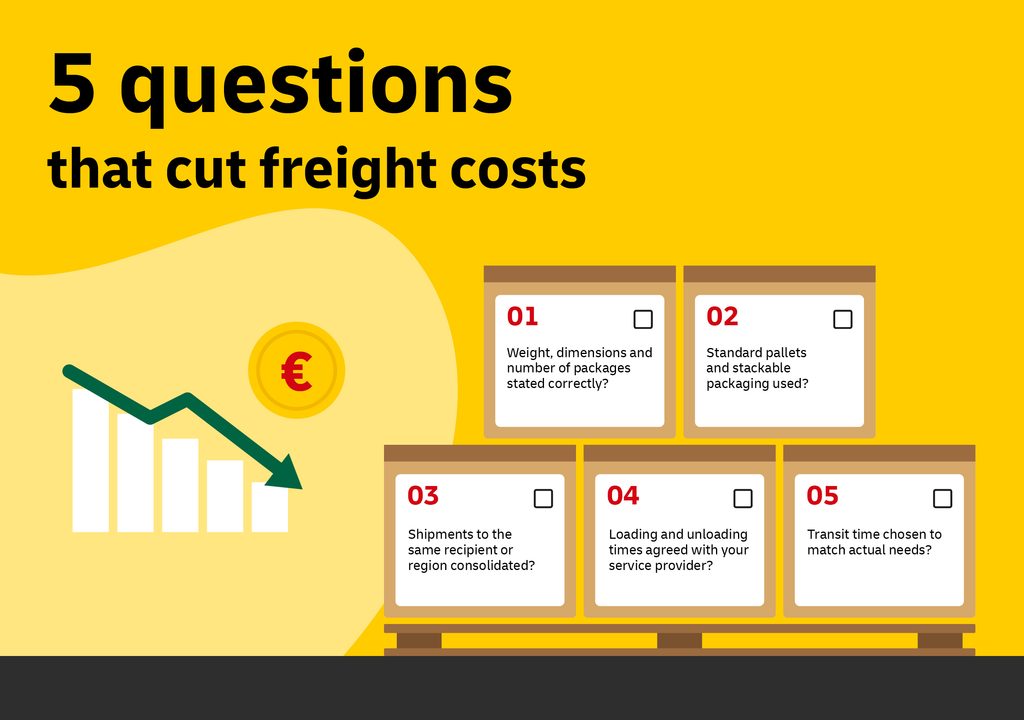
Additionally, some costs are solely the result of your shipping practices. You should regularly review the following points:
- At the time of booking, are the weight, dimensions, and number of packages stated completely and correctly?
- Do you use standard pallets and stackable packaging whenever possible?
- Are the shipments bundled by recipient or region?
- Have the loading and unloading times been coordinated with the service provider?
- Does the selected transit time align with the actual requirements?
Our guide on calculating transport costs explains how the individual components add up to a freight rate.
How does DHL Freight support shippers with predictable transport costs?
At DHL Freight, we operate one of the largest road freight networks in Europe, with over 180 terminals. Within this network, we consolidate shipments from various customers, which allows us to make better use of cargo space. This means shippers only pay for the space their shipment requires rather than paying for an entire truck.
- Lead time as required: with Road Freight Standard, Road Freight Priority, and Road Freight Direct, you choose the right product based on urgency and shipment size.
- Transparent surcharges: DHL Freight publishes current fuel and toll surcharge information on the respective national websites. The fuel surcharge is based on official diesel price data from the European Commission. Since March 2026, DHL Freight has adjusted it more frequently in several countries to ensure that it reflects actual price trends.
- myDHLFreight: through our customer portal, you can request quotes, book shipments, and track them. This allows you to see the costs before booking.
- Lead time calculator: the lead time calculator provides transit time information for international general cargo shipments and helps you weigh lead time against costs.
- Alternative drive systems: DHL Freight is deploying electric trucks in several countries and testing new drive concepts with partners like the BMW Group. Many EU countries are exempting zero-emission trucks from road tolls until 2029 or even mid-2031.
Conclusion: What can be done to mitigate rising transportation costs in 2026/2027?
In 2026 and 2027, the cost of road freight will primarily be affected by factors outside the transportation industry, such as diesel prices, CO₂ pricing, and tolls. Added to this are the driver shortage and rising wages. There is no quick relief in sight for any of these factors. With the launch of ETS2 in 2028, the next change is already certain.
Shippers have little influence over diesel prices, tolls, or CO₂ pricing. However, they can adjust their own shipping practices. These include optimizing shipments, using accurate data, minimizing dwell times, and selecting transit times based on actual needs. Those who proactively plan their capacity are also less affected by fluctuations in the spot market.
At DHL Freight, we support you with a Europe-wide network, transparent surcharges, and products designed for different transit times. Feel free to contact us anytime!
FAQs
What are the main cost factors in road freight transport?
The primary cost drivers in European road freight transport in 2026/2027 are diesel, truck tolls, CO₂ pricing, personnel costs, and fluctuating capacity. Diesel is the largest variable cost component. In Austria and Hungary, toll costs per kilometer have surpassed fuel costs.
How are transport costs structured in this sector?
Total transport costs consist of both fixed and variable costs. Variable costs include fuel, tolls, and tires, while fixed costs include the vehicle, insurance, and personnel. Additionally, there are surcharges for fuel and tolls, as well as transshipment and handling costs for general cargo.
To what extent did freight rates increase in 2026?
According to the European Road Freight Rate Benchmark, the contract rate index increased by 7.9 points, reaching 148.0 in the second quarter of 2026. Spot rates increased by 14.6 points to 146.8 during the same period. Higher diesel and operating costs were the primary drivers.
What impact will the ETS2 have on transport costs from 2028 onwards?
ETS2 is the European emissions trading system for the buildings and road transport sectors. Starting in 2028, the CO₂ price for fuels will be determined by the market across the entire EU rather than being set within a fixed range, as is currently the case in Germany. Although the exact price remains uncertain, it will directly impact diesel costs and, consequently, transport costs.
How can shippers reduce their freight costs?
Shippers primarily reduce their freight costs through high capacity utilization, consolidated shipments, and accurate shipment data. Short dwell times at the loading ramp and predictable shipment volumes make transport operations more efficient. Selecting transit times based on actual requirements and combining contract cargo with spot-market cargo is also helpful.