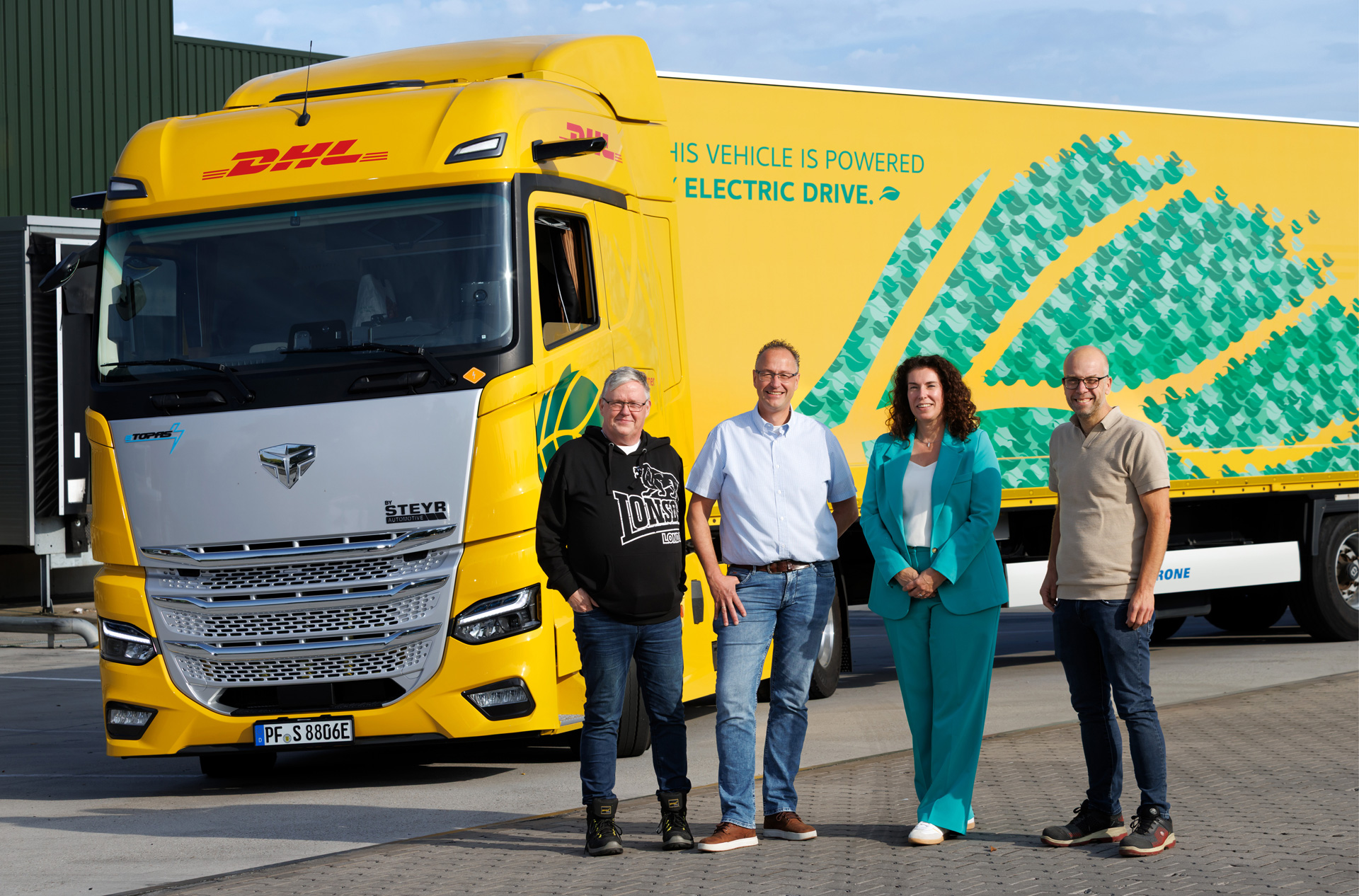
From pilot to daily operations: Since September, the first SuperPanther eTopas 600 manufactured in Europe has been operating within the DHL Freight network in the Netherlands, covering approximately 2,000 kilometres per week as part of regular commercial operations. This battery-electric heavy-duty truck travels on routes within the Netherlands and regularly crosses the border into Belgium. This is the most significant milestone yet in the partnership between DHL Freight and SuperPanther.
How did the eTopas 600 end up on Dutch roads?
The process of bringing the eTopas 600 to the road involved three stages. It began in the fall of 2024 at the IAA Transportation in Hanover, where SuperPanther and DHL Freight signed a memorandum of understanding to establish a strategic partnership. The two companies agreed to collaborate on low- and zero-emission transportation concepts for the road freight sector.
The second phase led to Austria. Initial test drives took place there starting in fall 2025. The decisive phase followed in spring 2026 and consisted of two weeks of continuous operation, covering approximately 1,900 kilometers and averaging 238 kilometers per day. The energy consumption was 102 kilowatt-hours per 100 kilometers. The team drove various routes, including the 400-kilometer stretch between Wels and Vienna. The results were promising and allowed for the next step: deployment with customers.
This marked the start of phase three. The vehicle rolled off the assembly line in July 2026, and by the end of August, it was transported from Austria to the Netherlands. On August 31, the local team took over; the eTopas 600’s first regular workday was September 1.
Why is DHL Freight operating the first production vehicle?
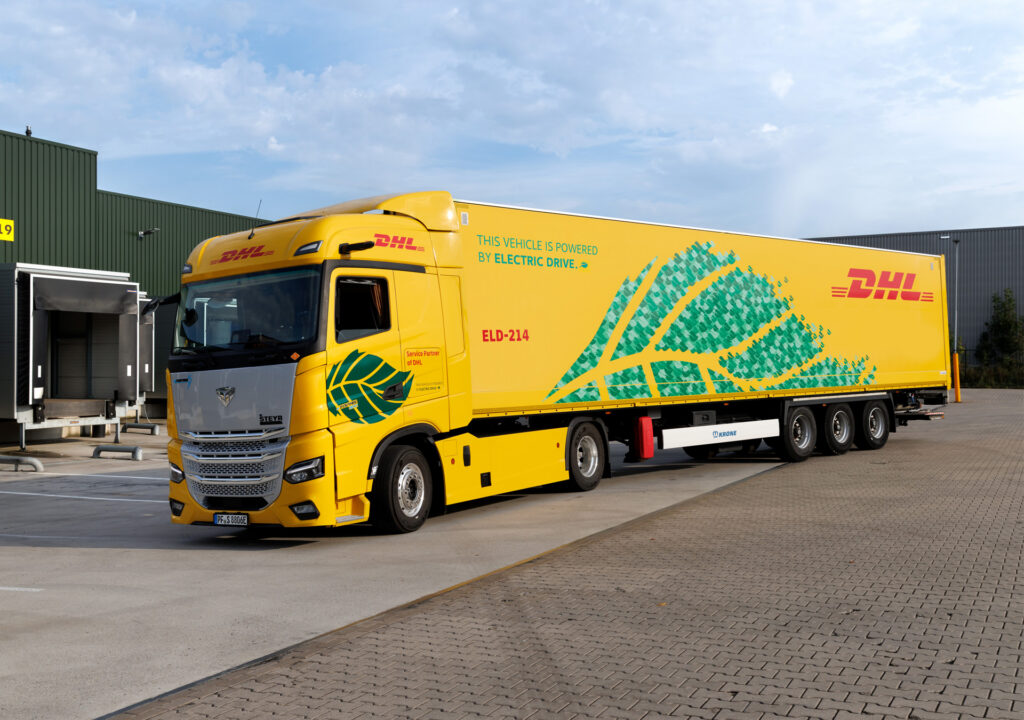
The eTopas 600 is being manufactured in Steyr, Upper Austria, for the European market. The first units in the series were produced at the Steyr Automotive GmbH plant and delivered to customers, which was made possible by a partnership between SuperPanther and Steyr Automotive. DHL Freight snapped up the first unit and brought it directly to customer operations instead of a showroom.
For us, this is more than just a footnote. The operator of the first production vehicle will collect the first reliable operational data on range under real-world load conditions, loading windows in route planning, and driver feedback.
Our experience from daily operations has been positive so far. The vehicle meets the requirements of the planned deployment profiles and achieves high productivity within the network. Feedback from drivers has also been very positive.
Arjan van Weelden
Carrier & Sustainability Manager, DHL Freight Netherlands
What technical features does the eTopas 600 have?
A young company created the vehicle. Founded in China in 2022, SuperPanther develops energy technologies for medium- and heavy-duty commercial vehicles. The company designed its first electric vehicle, the eTopas 600, specifically for the European market.
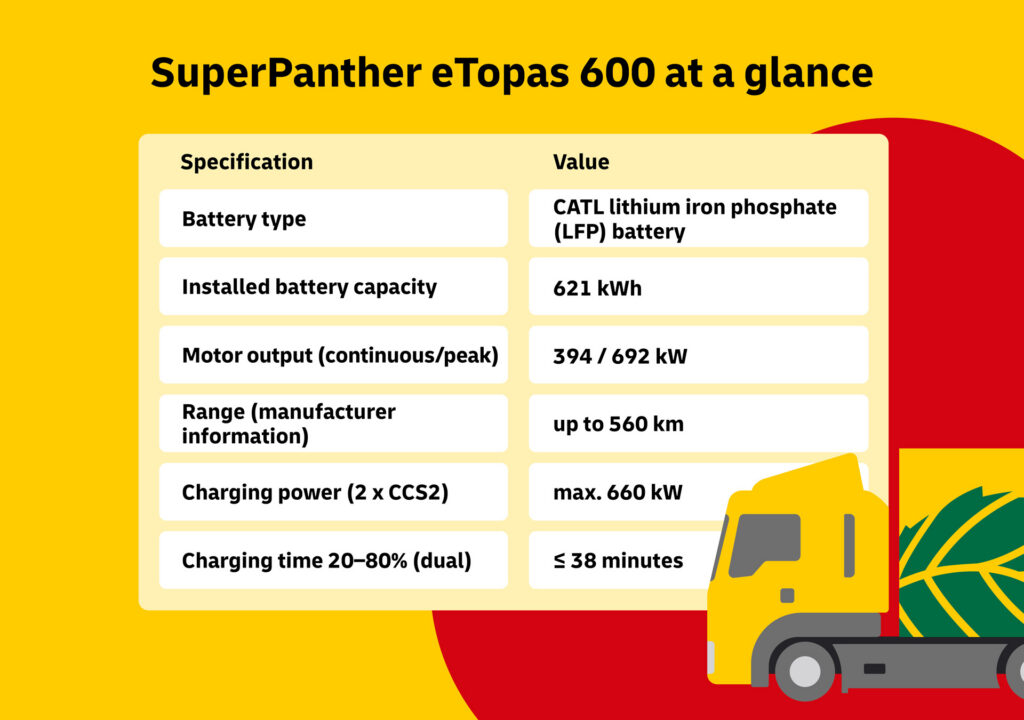
SuperPanther eTopas 600 at a glance
| Specification | Value |
| Battery type | CATL lithium iron phosphate (LFP) battery |
| Installed battery capacity | 621 kWh |
| Motor output (continuous/peak) | 394 / 692 kW |
| Range (manufacturer information) | up to 560 km |
| Charging power (2 x CCS2) | max. 660 kW |
| Charging time 20–80% (dual) | ≤ 38 minutes |
How does the eTopas 600 perform in day-to-day operations?
A practical test is conducted under controlled conditions, including a defined route, payload, and continuous monitoring. These precautions are not taken in regular operations. Instead, the vehicle is scheduled like any other truck, carrying customer shipments with fixed time slots and varying requirements.
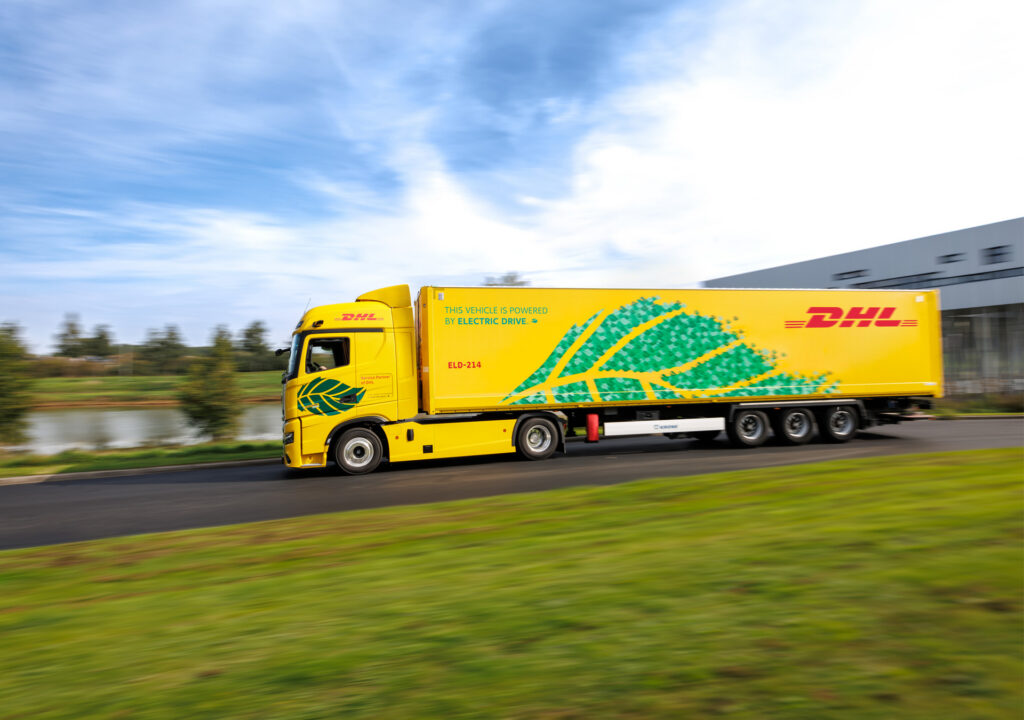
These are precisely the conditions that apply for the eTopas 600 in the Netherlands. The truck does not operate on a fixed route between two terminals; instead, it is scheduled flexibly, with national routes and regular trips across the border to Belgium. This adds up to about 2,000 kilometers per week. The vehicle is particularly well-suited for medium distances where charging breaks can be incorporated into the daily schedule.
The insights gained from this do not remain within the network. DHL Freight shares its operational experience with SuperPanther to contribute to the development of future vehicle generations.
What progress has DHL Freight made in terms of e-mobility?
The eTopas 600 is not an isolated case but represents a general trend within DHL Freight. Our fleet now includes approximately 1,700 vehicles with low-emission drive systems, and this number is growing. We are also evaluating new vehicle types and drive concepts to determine their suitability for regular service. Our ultimate goal is to achieve DHL Group’s objective of reducing all logistics-related emissions to net zero by 2050.
In the Netherlands and Belgium, the eTopas 600 is only the beginning. About 40 more electric vehicles will join the fleet in the coming months.
Our customers are looking for practical ways to reduce greenhouse gas emissions from their transport operations. That is why it is not enough for the technology simply to be available; it must also prove itself in day-to-day commercial operations.
Heidi van Eldik
CEO DHL Freight Netherlands & Belgium
Our approach is deliberately technology-neutral. In addition to e-mobility, we employ fuels like HVO 100 as well as bio-LNG and bio-CNG. We are also exploring long-term options, such as hydrogen technology.
In the field of electric road freight, additional projects include the trial deployment of BYD electric trucks in the greater Cologne area and Satair’s regular electric operations in Hamburg. With GoGreen Plus Services, customers can join us on our journey and reduce their own transportation emissions.
A vehicle that builds experience through daily use
Two years passed between the signing of the Memorandum of Understanding and the first customer shipment in the Netherlands. This time was necessary because electrification of heavy-duty freight transport is not decided theoretically, but rather by the question of whether a vehicle can withstand the daily demands of a freight network.
Since September, the eTopas 600 has been answering that question on the road with real cargo for real customers. What we are learning about range, charging behavior, and route planning feeds back into our partnership with SuperPanther – and contributes to the decision about which routes can be electrified next.
Would you like to know how low-emission transport can be integrated into your supply chain? Contact us – we would be happy to advise you.