
Transparency for every shipment at any time is standard practice in logistics, thanks to tracking and tracing. When implemented correctly, it creates sustainable added value and becomes a competitive advantage. What does tracking and tracing entail? Why is it indispensable? What challenges often arise? Which common technologies, such as GPS, geofencing, RFID, barcodes/QR codes, and IoT sensors, are particularly well-suited for which areas of application? Get the answers to these questions and more in this article.
Tracking and Tracing – Definition
Logistics specialists define tracking as the continuous location determination of shipments, load carriers, or vehicles, often in near real time. Tracing, on the other hand, involves backtracking process steps, status messages, and route points throughout the entire supply chain. Together, tracking and tracing systems provide a complete overview of a shipment’s past and present locations, as well as its expected delivery time.
Tracking vs Tracing
In other words, tracking provides the answer to the question “Where is the shipment?”, while tracing gives the answer to “How did it get there?” To compile this information and ensure a high degree of accuracy and timeliness, the data models and IT interfaces used in the logistics process must meet specific requirements.
Tracking and Tracing at a Glance
- Tracking = (near) real-time localization of shipments and assets – effectively answering the “Where is it?” question in tracking and tracing
- Tracing = backtracking the history (events, routes, statuses) – answering the question “Where was it when?”
- What’s it about: transparency, reliable ETAs (estimated time of arrival), less downtime, and fewer damaged or lost shipments. In short, tracking and tracing in logistics provides better, more reliable service quality.
- Technology: technical possibilities have become increasingly diverse. Common systems include: GPS/GNSS and geofencing, RFID (both active and passive), barcode/QR, mobile IoT/BLE/Wi-Fi, edge, and cloud.
- DHL Freight practice: active tracing, including an API option for a seamless connection to your systems. For global freight shipments, we offer myDHLi.
Why Tracking and Tracing Is Indispensable
Tracking and tracing systems offer tangible benefits to everyone involved in the supply chain, including consignors, logistics service providers, and recipients. One key advantage is that everyone involved has the same level of information, whether it’s scheduling, customer service, purchasing, production, or the recipient. This allows anyone to check the shipment status at any time, creating transparency and reliability without the need for time-consuming inquiries via telephone.
Better and More Reliable Process Control
Reliable ETAs improve the overall planning of logistics processes and increase delivery reliability. Proactive exception handling is also possible. For example, geofences and event triggers report deviations early on. Consequently, countermeasures can be implemented before service level agreement (SLA) requirements are potentially not met.
Improved Service Quality = Higher Customer Satisfaction
Thus, tracking and tracing creates significant added value in terms of service quality, reliability, and customer satisfaction. Seamless documentation (chain of custody) is crucial for ensuring that processes are audit-proof, especially in sensitive applications such as the pharmaceutical, automotive, chemical, and electronics industries. Today’s Internet of Things (IoT) sensor technology extends logistics tracking to include monitoring and documenting important parameters such as temperature, vibrations, and humidity.
Common Challenges and How to Overcome Them
The advantages of tracking and tracing demonstrate its crucial role in modern logistics. However, implementation presents challenges. We address the most common challenges and show you how to overcome them.
1. Data quality and master data
Without reliable data and references (shipment numbers, order IDs, SSCC/GTIN), there can be no tracking or tracing. Inconsistencies, not the technology itself, are often the cause of friction losses. Therefore, it is important to ensure high data quality by clearly defining data owners, validation rules, and KPIs, among other things.
2. Interfaces and integration
Many parties are involved in logistics processes, and the systems used are correspondingly diverse. One problem is that ERP, TMS, WMS, and carrier APIs use different “dialects”. For this reason, it is essential to define a central data model, maintain API interfaces, and use event streaming to make tracking in logistics scalable.
3. Data protection and security
A variety of regulations and legal principles must be observed when using personal or business-related data. Anonymization or pseudonymization, and clearly defined access concepts ensure data security, especially in applications such as geofencing.
4. Hardware and operation
The robustness and network coverage of the devices used, as well as the total cost of ownership (TCO), are the key considerations in any tracking and tracing rollout. The requirements of high performance and cost efficiency must be reconciled.
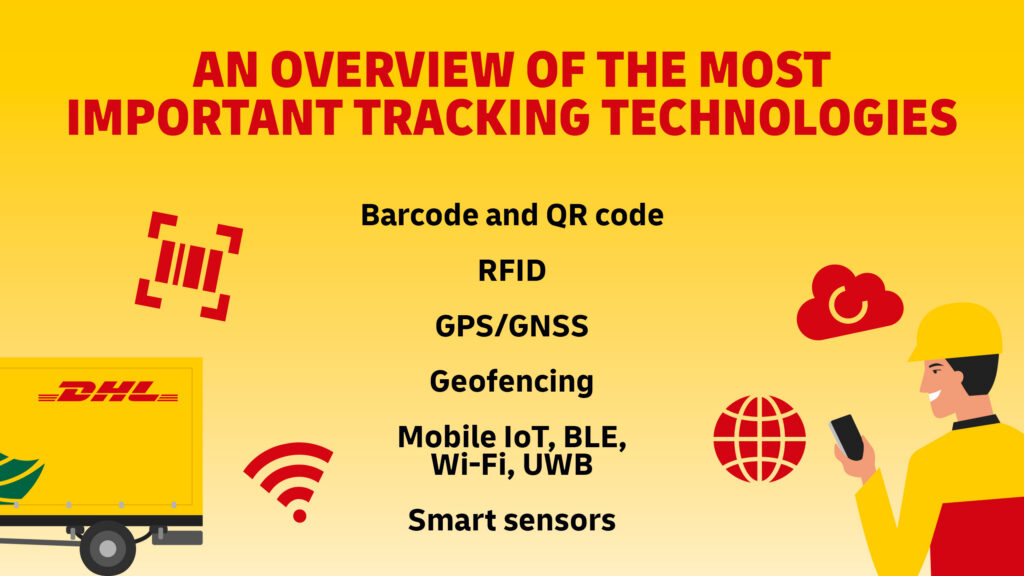
An Overview of the Most Important Technologies
A variety of technologies enable the tracking and tracing of shipments, each with different advantages and limitations. Often, seamless tracking requires a combination of several technologies.
Barcode and QR code
- Principle: 1D/2D codes that are captured by a scanner; inexpensive, universal
- Advantages: low cost, high availability, ideal for basic tracking scenarios
- Limits: no automatic remote location tracking; events only at scan points
RFID (passive/active)
- Principle: tags with radio chips; reading without visual contact, even at pallet level
- Advantages: high throughput, robust identification, high process speed – a strong foundation for tracking and tracing systems in warehousing/production
- Limits: invest in infrastructure/tags, metals/liquids as disruptive factors, depending on the frequency; one relevant distinction: passive RFID usually provides events for tracing, while active RFID can also provide tracking
GPS/GNSS (vehicle or asset tracker)
- Principle: satellite tracking, transmitted via mobile communications
- Advantages: comprehensive tracking and tracing transparency, reliable ETA calculation
- Limits: indoor/enclosures problematic, power supply required (practice: GPS-equipped trucks for complete track and trace visibility)
Geofencing
- Principle: virtual fences around ramps, hubs, routes; entering/leaving triggers events
- Advantages: automated tracking and tracing events (arrival/departure), alerts in case of deviations
- Limits: maintenance effort for geozones, GPS accuracy, and data protection
Mobile IoT, BLE, Wi-Fi, UWB
- Principle: localization via cell ID, Bluetooth beacons, Wi-Fi fingerprints, or ultra-wideband
- Advantages: supplements tracking where GNSS is limited (indoors)
- Limits: accuracy/coverage vary; hybrid approach tends to be best
Sensors (temperature, shock, humidity, light)
- Principle: IoT smart sensors record conditions; data flows into the tracking and tracing backend
- Advantages: quality assurance, compliance (GDP), claims reduction
- Practice: DHL SmartSolutions IoT & SmartSensor – visibility and monitoring along the chain
Practical Examples from Logistics: Tracking and Tracing Have an Immediate Impact
Transparency of shipments is almost always important for suppliers and recipients. However, there are cases where it is absolutely essential.
Automotive: just-in-time delivery without a safety net
The automotive industry’s just-in-time manufacturing requires stable, real-time tracking and tracing. Geofencing in factory zones automatically reports delayed trailers, and dispatchers reroute them. The result is less downtime, which has a measurable effect on efficient, precisely timed production.
Pharmaceuticals and life sciences: temperature guaranteed
IoT sensors monitor temperature and vibration. Events are documented in the portal, and deviations trigger SOPs. This makes tracking and tracing a compliance (GDP) support tool and reduces waste.
Retail/e-commerce: customer experience and stock turnover
Tracking can help optimize days inventory outstanding (DIO), reduce customer inquiries, and increase customer satisfaction. This application field relies on barcodes and QR codes at each station to track events and GPS to provide arrival times.
Implementation Guide: 7 Steps to Scalable Tracking and Tracing
The way tracking and tracing is implemented in your company varies from case to case. The following seven steps will help you find a suitable solution.
1. Determine goals and scope
Which key figures should be improved? Tip: Start with a specific focus, such as FTL Europe, and gradually expand your tracking and tracing.
2. Define data model and interfaces
Standardize events (source, time, location, status) and harmonize IDs (shipment, order, asset). This will facilitate the implementation of tracking and tracing systems.
3. Select technology mix
Use a hybrid strategy that combines GPS/geofencing for transport, RFID/barcodes for warehouses, and sensors for quality control to scale tracking.
4. Integrate platform
Use the API to connect to DHL Freight Active Tracing (or use the web portal) and centrally orchestrate tracking and tracing logistics in your TMS/control tower.
5. Processes and change management
Define who responds to alarms, how the escalation levels work, and how you feed tracking and tracing data back into planning and customer processes.
6. Pilot, measure, scale
Start with a limited pilot to measure KPIs and refine geofences and alerts. Then, expand tracking and tracing to other routines.
7. KPIs and ROI: how to measure success
- ETA accuracy (average deviation in minutes per hour) – the gold standard for tracking and tracing
- dwell time at hubs and ramps – an important key lever in logistics
- on-time delivery (OTD) and service level
- claims and loss ratio, DIO, number
Conclusion: From “Where’s My Shipment?” to the Predictive Supply Chain
Tracking and tracing systems have long been essential to high-performance logistics. The direction of further development is clear: systems are becoming increasingly intelligent. Thanks to AI, ETA forecasts are improving, IoT sensors are providing real-time status data, and control tower solutions are linking events to action-guiding workflows. All parties involved in the logistics chain benefit from improvements in quality, safety, and sustainability.