An increasing number of people own mobile robots for household tasks, such as vacuum cleaners and lawn mowers. Even these simple yet efficient systems hint towards the potential of autonomous mobile robot logistics for companies. Markets with high labor costs and demanding customers are particularly driving the adoption of robots. What is possible today, and what will the future bring?
The Essentials in Brief
Mobile robots used in logistics are various types of mobile systems that primarily perform transport or picking tasks, mainly inside buildings. They are not controlled directly by humans. There are two main types of mobile robots:
- Autonomous guided vehicles (AGVs) follow predetermined routes. These routes can be physically defined (e.g., by rails) or determined by means such as QR codes on the floor, magnetic strips, or radio signals.
- Autonomous mobile robots (AMRs) are further developed versions of AGVs. They autonomously plan their route in real time. They can avoid obstacles using 3D LiDAR (Light Detection and Ranging) technology and/or cameras, so they do not rely on physical or other guidance structures.
Significance of mobile robotics in logistics
The growing e-commerce market is causing an increase in both the absolute volume of items handled in logistics centers and the number of small transport units in low quantities. To meet customer demands, even in times of skills shortages, it is essential to have fast, efficient, flexible, and scalable warehouse logistics processes.
Mobile robots in summary
Mobile robots optimize warehouse logistics operations by speeding up processes and making them more precise. Thanks to digital interfaces, they have detailed information about every item in stock, resulting in a lower error rate and improved inventory control. They can also be easily scaled up or down in response to demand fluctuations. This enables a flexible response to peaks and lows.
Progressive Autonomization of Logistics Robots
In a sense, there is a fluent transition between stationary and mobile robots. Examples of established mechanical warehouse assistants include stationary robotic grippers and shelf robots. The latter travel along fixed tracks on warehouse shelves to store and retrieve goods. Although shelf robots are more mobile than grippers, their limited range of motion restricts their mobility.
AGVs which move along predetermined routes in the warehouse, are, in turn, more mobile than shelf systems, which are tied to their respective shelves. Mobile automation has evolved, and driven by AI and LiDAR technology, it now uses three-dimensional visual autonomy. Consequently, today’s mobile robots are not only more independent in their movements, but also more accurate and powerful.
Which Logistics Processes Can Be Improved With Robotics?
Despite their existing and projected capabilities, mobile robots are not intended to replace human labor; rather, they are meant to complement it. They free up resources for tasks in which humans can meaningfully utilize their full potential. In particular, employees are relieved of monotonous, time-consuming, dangerous, or unpleasant tasks, such as transporting items in cold storage rooms.
Mobile robots are well-suited for the following warehouse activities. Their advantage: they are not tied to the working hours of their human colleagues.
- Transport of heavy and/or bulky goods
- Storage and retrieval
- Sorting
- Order picking
Use Cases for Mobile Logistics Robots
Currently, AGVs dominate everyday warehouse logistics work, performing simple tasks that do not require complex decision-making or environmental adaptation, such as transferring packages or moving materials along fixed routes. However, there are other potential applications besides this established use case.
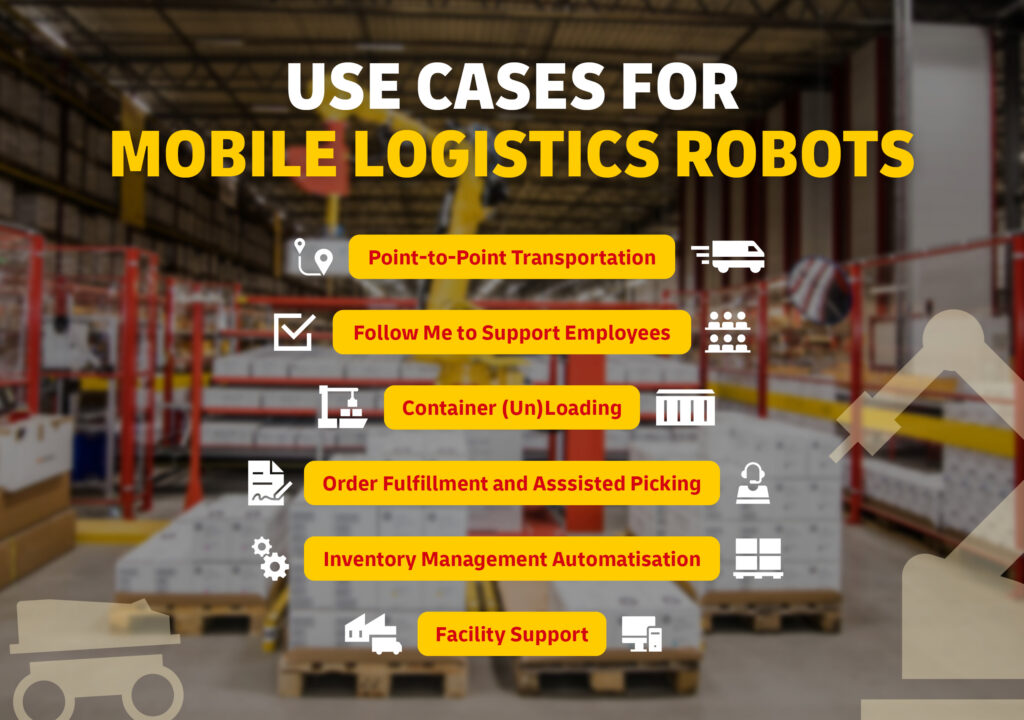
Point-to-Point Transportation
Transporting goods between two points in the warehouse is time-consuming. Using mobile robots is an effective way to reduce recurring workloads and walking distances for employees. A few employees can monitor a fleet of transport robots while the rest of the workforce takes on more valuable tasks.
There are numerous marketable solutions for transporting goods between fixed points. These systems are typically equipped with basic control technology. This includes sensors for track guidance and contact sensors, which allow the systems to follow simple sequences and stop safely when they encounter an obstacle.
Main types of devices for point-to-point transport are:
- 3D systems: such as autonomous forklifts or autonomous high-reach robots for pallet-picking and put-away tasks
- 2D systems: such as autonomous jack lifts, pallet jacks, or tugging robots
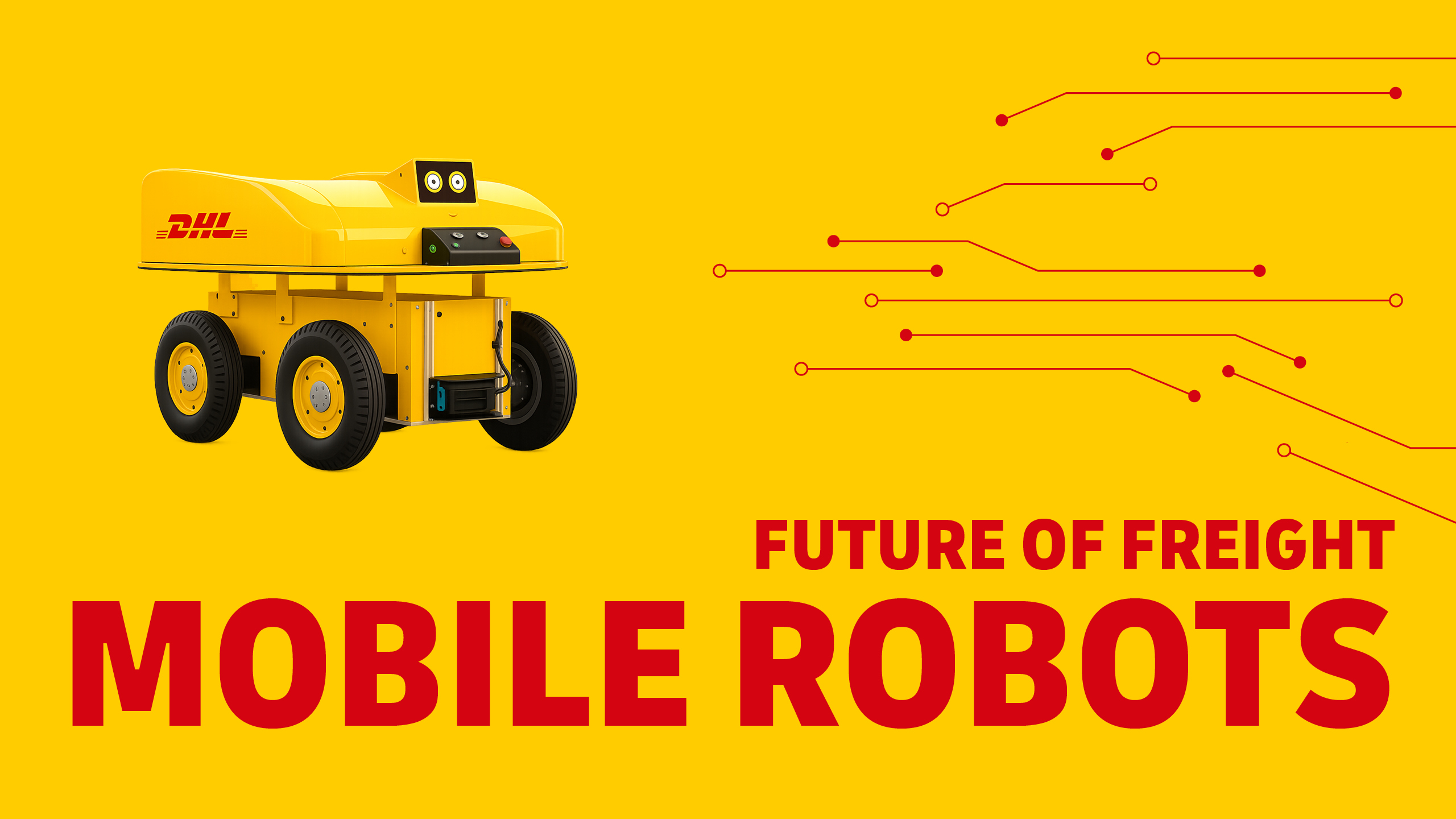
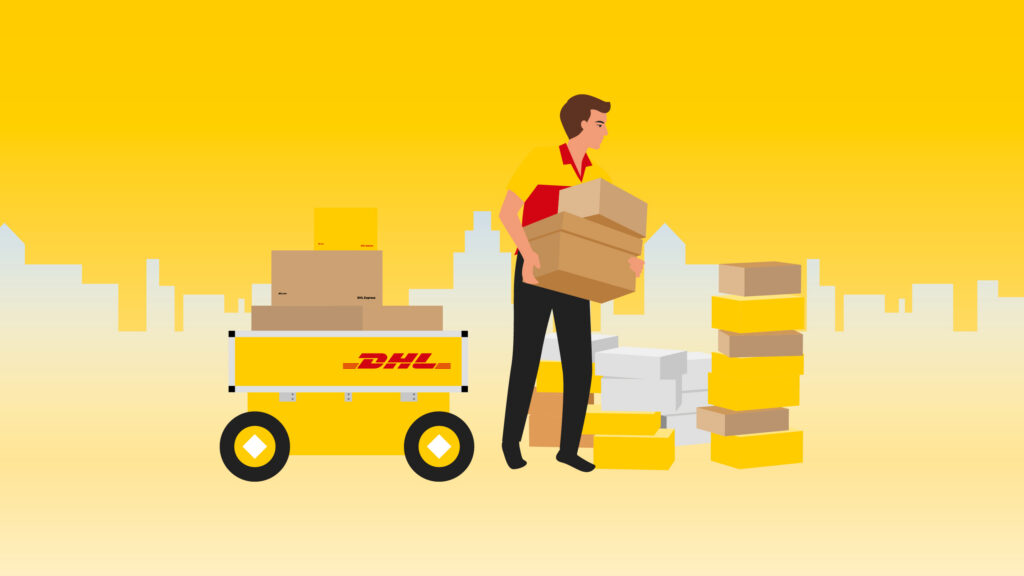
“Follow Me!“ – the EffiBOT from DHL
There are also solutions with a follow-me mode that allow robots to accompany people while carrying loads. These systems can be used in environments that are currently too complex for most fully autonomous AMR technologies. One example is the EffiBOT, which helps employees at DHL logistics centers.
During manual picking, employees’ carts quickly become too heavy. High order volumes limit picking to one order at a time and force employees to walk long distances. The EffiBOT is perfectly tailored to the needs of these employees. As a follow-me robot, EffiBOT moves alongside employees through the shelving system. Although it does not work autonomously, it carries loads, allowing employees to pick more items per tour.
The picker sends the EffiBOT to the storage location when its transport container is full. Thanks to its advanced navigation function, the EffiBOT drives autonomously to its destination. Sensors inform the EffiBOT about its surroundings and possible obstacles. This prevents collisions and increases safety. Meanwhile, another EffiBOT joins the employee to pick up new items.
This collaborative, automated picking process is an important step toward optimizing warehouse operations. Thanks to increased computing power, AI, and computer vision, such follow-me systems will become more autonomous, and more use cases will emerge.
Container (Un)Loading
Loading and unloading containers and loose-load trucks is physically demanding. Heavy goods must be moved quickly in confined spaces to ensure subsequent processes run smoothly.
Robust loading robots can perform such tasks. These devices have mobile bases for movement. They use gripper arms to pick up and transport goods. Cameras and sensors enable the robots to safely navigate and recognize objects of different shapes and sizes.
Currently, marketable systems are generally used to unload uniform cartons or pallets. In contrast, loading and unloading mixed cartons is complex and requires further research and development until scalable, fully autonomous solutions are ready for the market. Nevertheless, due to advances in software and image processing, it is reasonable to assume that mobile robots will soon be capable of performing additional autonomous tasks in the field of container loading.
Order Fulfillment and Assisted Picking
Picking robots can increase the efficiency of the order fulfillment process by reducing walking distances for employees and the time between picks.
Various types of order fulfillment applications exist, including goods-to-person solutions. One example is AMRs removing goods from shelves independently and transporting them to the picking or packing station. There, human workers can prepare the order for delivery without having to walk themselves.
Using AMRs to support order processing and picking allows employees to focus on accuracy and cover shorter distances each day.
Inventory Management Automatisation
As transport volumes increase, making optimal use of storage space becomes ever more important. One way to increase storage density is to implement an automated storage and retrieval system (ASRS).
An ASRS consists of a large number of computer-controlled components that automatically store and retrieve loads in and from storage locations. ASRSs enable autonomous handling of storage processes without human intervention. Effective ASRS solutions reduce space requirements and speed up order picking.
Although a complete ASRS requires a high initial investment, it pays off when handling large quantities of items with low and medium turnover rates.
Facility Support
Online retail grows, and so does the storage space. This quantitative expansion of warehouses makes high-quality building management increasingly important. Key factors here include cleaning, security, maintenance, and repair.
While cleaning and security robots are already available for use, robotics does not yet play a significant role in this area. These systems can navigate uneven terrain, and some can even climb stairs.
Although the use of mobile robots for warehouse cleaning and security is limited currently, they are expected to play a crucial role in the future of intelligent infrastructure for building management.
Do Humanoid Robots Have a Future in Logistics?
When the topic of robotics comes up, the image of a human-like robot with two legs, two arms, and a head usually comes to mind – like the golden C-3PO from Star Wars or the cartoon robot Bender from Futurama. Technologically speaking, the barrier to creating powerful humanoid robots is steadily dropping. But are such robots useful for logistics?
In logistics and many other areas of the economy, humanoid robots may seem like a good solution at first, but upon further inspection, they are not. For instance, is it sensible for robots to walk on two legs when wheels are a faster means of transportation in a warehouse? Similarly, equipping robots with two arms is impractical when one arm suffices for a task while three arms would be better suited for another.
Rather than replicating the human body, robots should be designed according to their tasks and with consideration for optimal collaboration with humans.
What Are the Potentials and Challenges of Mobile Robotics in Logistics?
In the long term, the use of robotics in logistics is less about reducing personnel costs and more about ensuring efficient logistics in light of the current and projected shortage of skilled workers.
The potential benefits of effective robotics solutions have already become apparent through the use cases:
- Reduced personnel requirement
- Reduced space requirement
- Lower error rate
- Improved scalability in case of demand fluctuations
- Process acceleration
- Lower operating costs
Together, all of this increases operational efficiency and productivity. However, the potential of mobile robots varies from company to company.
In addition to the high investment costs, there are technical challenges to overcome, depending on the system:
- Robotic systems must meet IT security requirements.
- High-performance software solutions are required for the integration of automated robot solutions from different manufacturers and warehouse management systems.
- A large number of employees and numerous obstacles in the warehouse complicate integrating mobile robots into operational processes. A comprehensive safety and risk analysis is required.
- Maintenance forecasts must be reliable and repair services must be carried out quickly to avoid expensive downtime.
Mobile Robots and the Future of Logistics
Mobile robotics in logistics is currently in the midst of a transformative process. To fully exploit this technology’s potential, powerful robot hardware and advanced AI technologies are needed for better orientation and object recognition.
Numerous applications for mobile robots in logistics are already in use and being scaled up. However, not all available mobile robot technology can be used in every warehouse yet. The technology needs to mature further, and decision-makers need to gain more confidence in it.
As both reliability and trust increase, mobile robots will be able to automate and support much of the work in warehouses alongside stationary robots, thereby increasing efficiency throughout the entire supply chain in the foreseeable future.